Reading: Pages x–31
Live Session: February 1, 2026 8am UTC
Zoom links are sent by Newsletter, Facebook and WhatApp
Reading Summary
This foundational section establishes Iyengar’s philosophical framework for understanding prāṇāyāma as the “heart of yoga.” Beginning with traditional invocations to Hanumān and Patañjali, Iyengar presents yoga as a comprehensive system for self-realization rather than mere physical exercise. He outlines the eight limbs of yoga, emphasizing how prāṇāyāma serves as the crucial bridge between external practices (yama, niyama, āsana) and internal disciplines (pratyāhāra, dhāraṇā, dhyāna, samādhi). The text explores the subtle anatomy of prāṇa through the lens of Sāṅkhya philosophy, introducing the concept of five sheaths (kośas) that envelope the soul and the intricate network of nāḍīs and chakras through which vital energy flows. Iyengar connects ancient wisdom with modern respiratory physiology, demonstrating how conscious breathing practices can purify the nervous system and prepare the practitioner for deeper spiritual work.
Questions to Guide Your Reading
Read these before you start the assigned pages. They’ll help orient your attention.
Who is Ādi Śeṣa and why does Iyengar invoke him at the beginning of the Haṭha Yoga Pradīpikā reference?
What are the five kośas (sheaths) and how do they relate to prāṇāyāma practice?
How many nāḍīs does Iyengar say originate from the heart, and which Upaniṣad is he referencing?
Reflection prompts
Read these during or after you read to connect the teachings with your embodied experience.
How does your current understanding of breath compare to Iyengar’s description of prāṇa as cosmic energy?
When you practice āsana, do you experience the subtle body (energy, breath, awareness) or primarily the physical body?
How do you personally experience the connection between breath awareness and mental states?
Recording of Session
Notes from our Sessions
In our opening session, we returned to the basic questions that hold up Iyengar’s entire approach: What is prāṇa beyond “breath”? What does prāṇāyāma actually mean—breath work, or something far deeper? And what does it mean to be ready? Through close reading, we explored Iyengar’s broad definition of prāṇa and worked with the five vāyus (prāṇa, apāna, samāna, udāna, vyāna). We also practiced pronunciation together—pūraka, recaka, kumbhaka—so these terms could move from the page into the mouth and body. We then faced Iyengar’s precise anatomical description of a complete prāṇic breath, and asked honestly: can we grasp this through reading alone, or is this exactly why he calls prāṇāyāma an art? To illuminate Iyengar’s opening move, I shared my short article on hiraṇyagarbha—the “golden embryo”—and why he frames prāṇāyāma cosmologically: not as something invented for modern needs, but as a practice rooted in a primordial source.
Alongside the text, we spoke openly about what actually blocks practice: lack of time, fear of doing it “wrong,” mental overload, physical fatigue, and the weight of Iyengar’s statement that prāṇāyāma should not be attempted until āsana is “perfected.” Participants shared how simple breath awareness supports them in daily stress and crisis moments, and we addressed the common feeling that prāṇāyāma can seem “boring” compared to the excitement of āsana (including my ocean-wave metaphor: the breath becomes endlessly interesting when attention refines). I also shared personally that in periods of trauma and overwhelm, prāṇāyāma can amplify what is already present—sometimes requiring us to step back, stabilize, and approach gently. In breakout discussions, we arrived at an important insight: prāṇāyāmic breathing is introduced from the very beginning through āsana, and the real question is not “when am I perfect enough?” but “how do I grow gradually and appropriately?” We closed with the four stages from the Śiva Saṃhitā, a reassuring map that normalizes struggle and reminds us that this path unfolds over years—sometimes over a lifetime.
Want to Go Deeper?
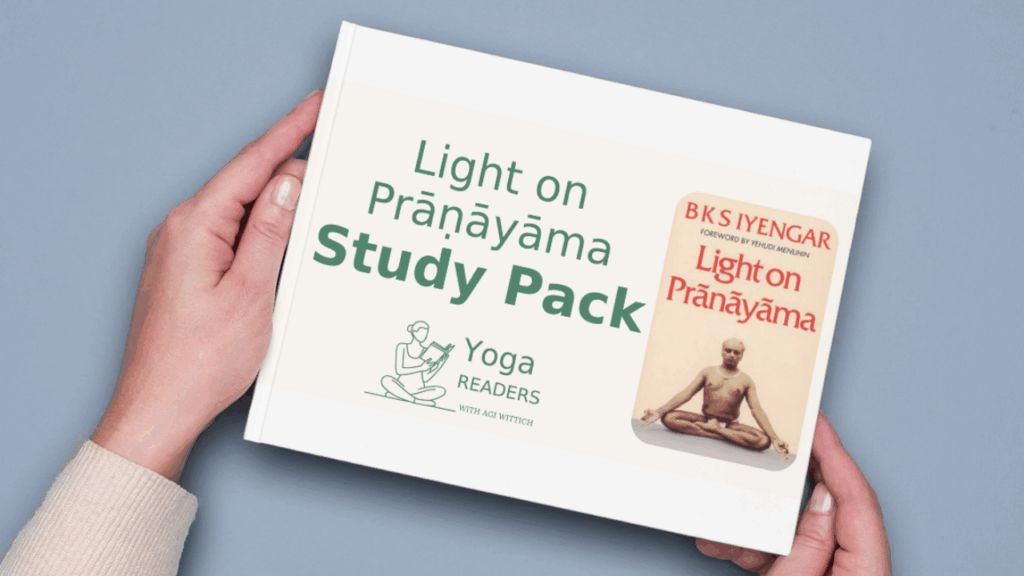
This session is part of the Light on Prāṇāyāma Study Pack – a complete resource for those who want ongoing access to all the recordings, study questions, and materials from this cycle.
The Study Pack includes all session recordings (watch and rewatch at your own pace), the complete Study Companion PDF with reading schedule, focus questions, reflection prompts, and practical tools for teaching, key Sanskrit terms with explanations, and a curated bibliography for further exploration.