Light on Life: Closing Communal Session
Live Session: Sunday, December 13, 2026 | 08:00 UTC The...
Read MoreKnowledge, Practice, and Healing
We have sent a 6-digit verification code to your email. Please enter it below to continue.
We have sent a 6-digit verification code to your email. Please enter it below to continue.
Live Session: Sunday, December 6, 2026 | 08:00 UTC
Our reading of Light on Life begins with Chapters 6 & 7.
The final two chapters of Light on Life bring Iyengar’s inward journey to its deepest point and then, importantly, turn it outward again. Having moved through the physical, energetic, mental and intellectual layers of our being, Chapter 6 reaches ānandamaya kośa, the bliss body. Yet bliss is not presented simply as happiness, pleasure, or an extraordinary experience to be pursued. It belongs to the progressive integration of the different layers of the human being and to the gradual loosening of the divisions between body, mind, intelligence and soul.
This brings Iyengar to samādhi, the state of absorption in which the divisions that ordinarily structure our experience begin to dissolve. But samādhi is not where Light on Life ends. This distinction is important: an experience of absorption, however profound, is still not identical with the lasting freedom toward which yoga is directed. Iyengar is also wary of attempts to manufacture extraordinary spiritual experiences. His discussion of kuṇḍalinī emphasizes that such transformation cannot simply be forced through technique. It arises through the integration and purification of the different layers of our being. The inward journey therefore cannot be bypassed in search of a dramatic “peak” experience.
The chapter also returns us to the question of what sustained practice means over the course of a life. Iyengar’s image of the tennis player who never retires becomes a way of thinking about bhakti, devotion, and the fact that yoga has no final season in which the practitioner can simply declare the work complete. The movement inward is not a project that we finish. Practice continues, and the relationship between effort, surrender and devotion continues to deepen.
Chapter 7 then asks what happens after the inward journey. If samādhi is a profound state of absorption, what does freedom look like when we return to ordinary life? Iyengar turns here to kaivalya, the freedom of the Self. Rather than presenting liberation simply as withdrawal from the world, he is concerned with how freedom is expressed through action. The yogi continues to live, relate to others and participate in the world, but action no longer arises from the same patterns of ego, desire and attachment.
This is where Iyengar introduces the idea of actions that are “without colour.” Ordinary action is coloured by our desires, fears, attachments and identification with the ego, and therefore continues to create karma and bondage. The liberated person still acts, but action arises from an undivided Self and does not create the same binding consequences. Freedom, then, is not measured only by what happens in meditation or in moments of absorption. It becomes visible in how one acts after returning to the world.
This also allows Iyengar to return, at the end of the book, to something that stood at the very beginning of the yogic path: yama and niyama. At the beginning, ethical principles may be experienced as disciplines that we consciously try to follow. At the end of the journey, Iyengar presents them differently: they become the natural expression of a person whose different layers have been integrated. Ethics therefore reappears not simply as a set of rules imposed upon the practitioner, but as the way inner freedom expresses itself in relationship with other people and with the world.
Read together, Chapters 6 and 7 complicate any simple idea that the journey of yoga ends when we finally reach an “inner” spiritual state. The movement of Light on Life has taken us from body to energy, mind, intelligence and bliss, but the final movement is back into life. Samādhi must be considered alongside kaivalya; inner integration alongside action; stillness alongside conduct; freedom from bondage alongside compassionate participation in the world.
In this sense, the end of Light on Life brings us back to the central question with which we began: What is the inward journey for? Iyengar’s answer is not simply the attainment of an extraordinary inner experience. The journey through the different layers of our being changes the quality with which we return to ordinary existence. The culmination of yoga is therefore revealed not only in what the practitioner experiences inwardly, but in how that understanding is lived.
Questions to Guide Your Reading
Read these before you start the assigned pages. They’ll help orient your attention.
Reflection prompts
Read these during or after you read to connect the teachings with your embodied experience.
This section will be updated after our live session with key points, questions, and reflections from our discussion.
The Light on Life Study Pack is meant for dedicated students and teachers who want everything in one place.
This makes sense if you join late and want to catch up thoroughly, like to re-watch and take notes at your own pace, and want a compact resource you can revisit over months and years.
The Light on Life – Study Pack includes:
* All study session recordings (ongoing access)
* The Study Companion PDF — reading schedule, main themes, summaries, focus questions, reflection prompts, and Sanskrit terms for each gathering.
* Guiding and reflection questions, organised by session
* Sanskrit terms with transliteration and explanations
Buying the Study Pack is one way to support the time and research that go into Yoga Readers — and to receive a resource designed for long-term study.
Live Session: Sunday, December 13, 2026 | 08:00 UTC The...
Read MoreLive Session: Sunday, December 6, 2026 | 08:00 UTC Our...
Read MoreLive Session: Sunday, November 22, 2026 | 08:00 UTC Our...
Read MoreLive Session: Sunday, November 8 2026 | 08:00 UTC Our...
Read Moreשלמו עבור המפגש 60 ש”ח כאן תוכלו לשלם באשראי, מי שמעדיפ.ה לשלם בהעברה סנקאית, ביט או פייבוקס – מוזמנים לשלם ולשלוח לי צילום מסך.
Updated schedule: Our Light on Life reading cycle has been postponed to January 2027. A global reading journey through B.K.S. Iyengar’s luminous map of
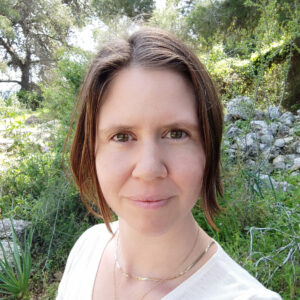
Agi Wittich is a yoga practitioner since two decades, and is a certified Iyengar Yoga teacher. Wittich studied Sanskrit and Tamil at the Hebrew University of Jerusalem, Israel, completing a PhD with a focus on Hinduism, Yoga, and Gender. She has published academic papers exploring topics such as Iyengar yoga and women, the effects of Western media on the image of yoga, and an analysis of the Thirumanthiram yoga text.