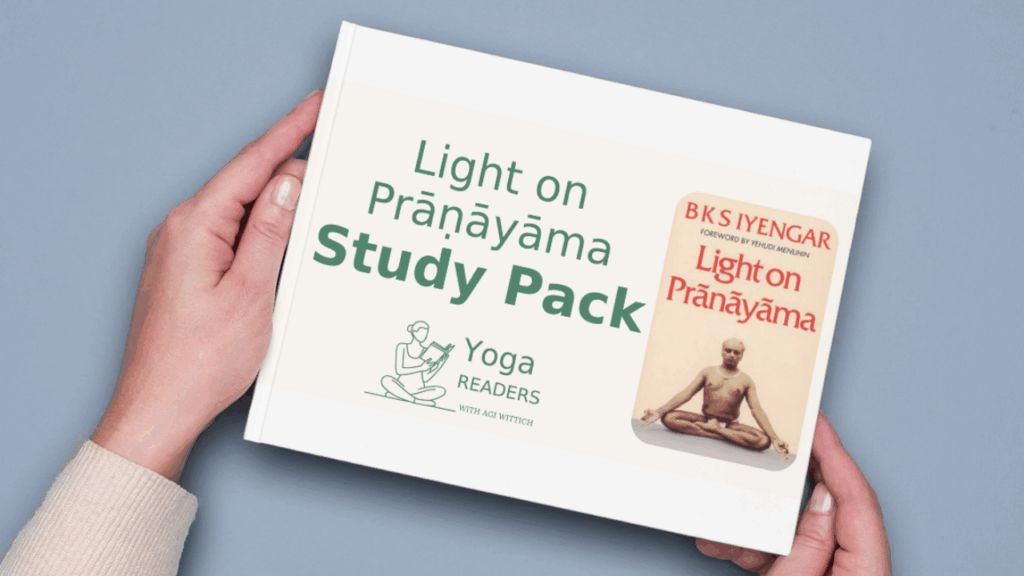
In this session, we focused on Chapters 19 and 20 of Light on Prāṇāyāma, where Iyengar introduces Ujjāyī and Viloma Prāṇāyāma. We began with the etymology of Ujjāyī. We moved into the structure of the chapter. I pointed out that Iyengar begins with lying down as a methodological choice, since in the supine position, the back body is supported, and the breath can be observed without the effort of holding oneself upright.
We looked closely at his instruction that all prāṇāyāma begins with exhalation. Before expansion, there is release. I invited participants to reflect on their own experience, and many shared that exhalation is more difficult than inhalation. I found this very interesting. I said that this reverses our common assumption that inhalation is the active phase and exhalation passive. In practice, letting go is often more demanding than taking in.
We then examined the table of stages in Ujjāyī. I acknowledged that these tables can be confusing. I said that they meant to be understood as patterns of variation: normal breath, deep breath, prolonged breath, and eventually retention. I also addressed the question of sound. Iyengar clearly describes a subtle sound in inhalation and exhalation, yet in modern practice this is often exaggerated or misunderstood. I suggested that the sound should not harden the throat. It is not something we impose, but something that emerges when the breath is guided with sensitivity. Another point that drew attention was Iyengar’s description of the sinus pathways. I said honestly that this is difficult to perceive. I invited participants not to force an experience, but to remain curious. Sometimes understanding comes through practice over time, not through immediate recognition.
We then moved to Viloma Prāṇāyāma. I explained that loma relates to the natural direction, and vi-loma suggests going against or interrupting that flow. I said that Viloma introduces interruption into continuity, and that this has a profound effect on awareness. I also shared an analogy Iyengar gives: climbing a ladder. In Viloma, we ascend step by step, pausing at each stage. This transforms breathing into a process of articulation, rather than a continuous wave.
I ended by reminding us that reading alone is not enough. These texts are meant to be practiced, questioned, and lived. The conversation between text and body is where understanding deepens.