
Knowledge, Practice, and Healing
Knowledge, Practice, and Healing
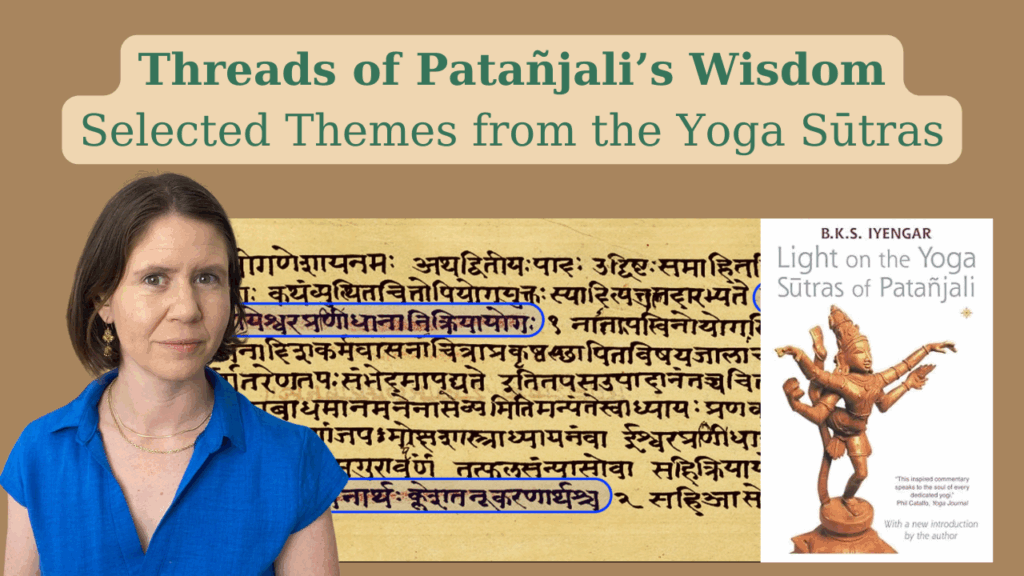
Thank you for registering for Threads in Patanjali’s Wisdom online course with Dr. Agi Wittich
This page contains everything you need for eight weeks of rigorous inquiry into Patañjali’s Yoga Sutras: all sutras in Sanskrit, all reading materials, all reflective questions, and access to session recordings.
Course Duration: December 2, 2025 – January 20, 2026
Meeting Time: Tuesdays, 8:00-9:00am UTC
In this orientation session we’ll explore the structure and history of the Yoga Sutras, the role of Vyāsa’s commentary in the tradition, and our three-perspective methodology (classical, embodied, scholarly).
Before the first session, consider the following questions:
You may be invited to share some of these in the zoom Session, but only if you’re comfortable.
We explore Patañjali’s foundational definition: “Yoga is the control of mental modifications.”
We’ll examine what does citta mean? What are vṛtti? What does “nirodha” mean? How do we work with the turbulent mind?
We’ll discuss three perspectives: Vyāsa’s classical commentary, Iyengar’s practitioner interpretation, and contemporary scholarly analysis.
Before our session, try the following:
Close your eyes for one minute and simply observe your mind. What do you notice? Is it busy? Quiet? Scattered? Focused? Anxious? Calm? How would you describe the quality of your mental activity? Have you ever experienced a moment of complete mental stillness—even briefly? What tends to make your mind more turbulent? What tends to calm it? When you practice āsana (if you do), what happens to your mind? Does it become more still or more busy? Have you ever been so absorbed in a pose that thoughts stopped?
We explore the twin pillars that support all yogic transformation: अभ्यास (abhyāsa – practice) and वैराग्य (vairāgya – detachment).
We’ll examine: What makes practice “firmly grounded”? What does detachment actually mean (and what it’s NOT)? How do these two seemingly opposite forces work together? What sustains practice over time?
We’ll learn Vyāsa’s framework, Iyengar’s embodied understanding, and contemporary analysis of how practice transforms consciousness.
Before our session, consider: What does the word “practice” mean to you? Do you have a regular yoga practice? If yes, how did you develop it? If no, what gets in the way? Can you tell the difference between committed effort and straining/forcing? What’s the difference between detachment and apathy? Do you tend more toward effort (pushing, striving, doing) or ease (flowing, receiving, being)? Which is harder for you: showing up consistently, or letting go of outcomes?
We explore Patañjali’s teaching on āsana, and more specifically, what might be the most misunderstood element of the Yoga Sutras. In just three sutras (2.46-48), Patañjali defines posture as “steady and comfortable,” achieved through “relaxation of effort and meditation on the infinite,” resulting in freedom from “the pairs of opposites.”
We’ll examine: What does āsana actually mean in Patañjali’s system? How can posture be BOTH steady (sthira) AND comfortable (sukha)? What is “relaxation of effort” (prayatna-śaithilya). Does this mean no effort, or a different quality of effort? What does “meditation on the infinite” (ananta-samāpatti) have to do with physical posture? Why does Patañjali dedicate only three sutras to āsana when modern yoga makes it primary?
We’ll discuss three perspectives: Vyāsa’s classical commentary (āsana as meditation seat), Iyengar’s embodied mastery (āsana as gateway to all eight limbs), and contemporary scholarly analysis (Maas on the historical evolution of āsana, O’Brien-Kop on embodiment and philosophy).
Before our session, try the following:
Choose one āsana you can hold comfortably for 3-5 minutes (seated or reclining posture works well). Practice holding it and observe: Where in this pose do you feel steadiness (sthira)? Where do you feel ease or comfort (sukha)? Can both exist simultaneously, or do you toggle between them?
As you hold the pose, notice where you’re making unnecessary effort. Is your jaw clenched? Shoulders gripped? Breath held? Can you maintain the structure of the pose while softening what’s not needed? What happens to your mind as you hold the pose: does it become more settled or more agitated? At what point do you want to come out of the pose, and why? Is it physical necessity or mental restlessness?
Now try this: In the pose, deliberately add more effort than necessary (grip, push, force). What happens to your breath? Your mind? Then try the opposite: release all effort, and let the pose become completely passive. What happens? Can you find the place between these extremes? Where the pose has just enough engagement to be steady but enough ease to be sustainable? That’s the inquiry Patañjali invites.
We explore Patañjali’s teaching on prāṇāyāma (breath and life force). In sutras 2.49-53, Patañjali describes prāṇāyāma as the “restraint of the movement of inhalation and exhalation,” achieved through attention to place, time, and number, becoming “long and subtle,” and ultimately removing the coverings (āvaraṇa) over the inner light.
We’ll examine: What is prāṇa? What does it mean to “restrain” (viccheda) the breath? What are the three aspects of prāṇāyāma practice (external, internal, and suspended)? How does prāṇāyāma prepare consciousness for concentration? Why does Patañjali say prāṇāyāma makes the mind “fit” (yogyatā) for dhāraṇā?
We’ll discuss three perspectives: Vyāsa’s classical commentary (prāṇāyāma as technical breath retention), Iyengar’s embodied precision (prāṇāyāma as intelligence of breath working with consciousness), and contemporary scholarly analysis (Bryant on the mechanics, Bachman on prāṇa as life principle).
Before our session, try the following:
Sit or lie comfortably and observe your natural breath for 2-3 minutes without changing it. Notice: Where does the breath move in your body? Chest? Abdomen? Sides? Back? Is it shallow or deep? Fast or slow? Smooth or irregular? Does it change as you watch it?
What happens to your mind during this practice? Does it become more focused or more scattered? What happens to the quality of your thoughts? Do you feel more energized or more calm afterward? Is there more space? More awareness? What “covering” (distraction, agitation, dullness) has been removed, even temporarily? This is what Patañjali means by āvaraṇa—prāṇāyāma reveals the light that was always there but obscured.
We explore Patañjali’s teaching on the obstacles that prevent practice and the afflictions that bind consciousness. In sutras 1.30-33 and 2.3-11, Patañjali describes the nine antarāyas (obstacles like disease, dullness, doubt) and the five kleśas (afflictions: ignorance, I-am-ness, attachment, aversion, clinging to life), showing how they operate and how to work with them.
We’ll examine: What is the difference between obstacles (antarāyas) and afflictions (kleśas)? Why does everyone encounter them. Are they personal failings or universal features of existence? What are the four states of kleśas (dormant, attenuated, interrupted, fully active)? How does ignorance (avidyā) give rise to all other afflictions? What is the antidote Patañjali offers in 1.33 – the four attitudes (maitrī, karuṇā, muditā, upekṣā)? How do we destroy kleśas in their subtle and gross forms?
We’ll discuss three perspectives: Vyāsa’s classical framework (two types of obstacles, karmic roots, meditation as remedy), Iyengar’s practitioner wisdom (obstacles as curriculum, practice as laboratory), and contemporary scholarly analysis (Whicher on kleśas as cognitive-affective errors, Bryant on the four states).
Before our session, try the following:
Review the nine obstacles (antarāyas) and identify which ones are active in your life right now. Which one stops you from practicing most often?
Notice: How do your habitual reactions (envy, judgment, resentment, anger) agitate your mind? How do the four attitudes (friendliness, compassion, joy, equanimity) clarify your mind? This is what Patañjali means by citta-prasādana—mental clarity through cultivating specific responses.
We explore Patañjali’s core metaphysical teaching on the relationship between consciousness (puruṣa, the seer) and matter (prakṛti, the seen). In sutras 2.17-25, Patañjali describes their conjunction (saṁyoga) as the cause to be avoided, explains the nature of both seer and seen, and reveals that liberation (kaivalya) comes from their separation.
We’ll examine: What is the seer (draṣṭṛ/puruṣa), pure consciousness, unchanging witness? What is the seen (dṛśya/prakṛti), everything perceivable, constantly changing? How can they be in conjunction if they’re fundamentally different? What is the cause of conjunction (ignorance, avidyā)? What does it mean that “the seen exists only for the sake of the seer”? What is kaivalya (liberation), isolation, integration, or something else?
We’ll discuss three perspectives: Vyāsa’s classical dualism (seer and seen are fundamentally distinct, like moon reflected in water), Iyengar’s embodied wisdom (the lame man and blind man analogy, practicing discrimination on the mat), and contemporary scholarly debate (Bryant and O’Brien-Kop on possible integration, both on realist vs. idealist readings).
Before our session, try the following:
Practice this investigation: Notice a sensation in your body (pressure of sitting, breath moving, temperature), and ask yourself: What is being experienced (the sensation—the SEEN)? Who/what is aware of the experience (the awareness—the SEER)? Can you distinguish between the sensation itself and the awareness of the sensation?
Now notice a thought arising and ask the same questions: What is the thought (the SEEN—content of consciousness)? Who/what is aware of the thought (the SEER—consciousness itself)? Are they the same thing or different? Can the awareness exist without the thought? Can the thought exist without awareness?
In your āsana practice this week, practice the discrimination: The body stretches, holds, releases (SEEN). But what is aware of all this? What witnesses the body’s sensations without being the sensations itself (SEER)? Can you maintain this distinction—not just philosophically but experientially?
Notice: When you identify with what you’re experiencing (“I AM this body/thought/emotion”), how does that feel? When you recognize yourself as the witness of experience (“I am aware of this body/thought/emotion”), what changes? This is viveka (discrimination), the core practice leading to kaivalya.
We complete our journey through Patañjali’s Yoga Sutras by integrating all seven previous sessions into a coherent understanding of the path. We’ll revisit the key teachings, examine how they connect and build upon each other, and explore what happens now. How do you continue this practice of philosophical inquiry?
We’ll examine: How does each session build on the previous? What is the progression from understanding yoga (Session 2) to practicing it (Session 3) to preparing the body (Session 4) and breath (Session 5) to navigating obstacles (Session 6) to discriminating seer from seen (Session 7)? Where are the tensions, contradictions, unresolved questions in Patañjali’s system? What have the three lenses (classical, embodied, scholarly) revealed that you wouldn’t have seen with just one?
We’ll synthesize: Vyāsa’s systematic framework, Iyengar’s embodied wisdom, and contemporary scholarly insights into a multi-dimensional understanding of what yoga philosophy IS and what it DOES. We’ll explore how to continue the practice of rigorous inquiry, how to read other philosophical texts with the tools you’ve developed, and how to integrate this study into your ongoing practice.
Before our session, try the following:
Create a synthesis map: Write “YOGA” in the center of a page. Around it, write the key teachings from each session: citta-vṛtti-nirodhaḥ (restraint of mental fluctuations), abhyāsa-vairāgya (practice and detachment), sthira-sukha (steady and comfortable), prāṇāyāma (breath regulation), kleśas (afflictions), viveka (discrimination between seer and seen). Draw lines connecting them—how does each relate to the others? Which teaching has been most transformative for you? Which has been most challenging?
Reflect on the three lenses: What did Vyāsa’s classical commentary teach you that you wouldn’t have learned otherwise? What did Iyengar’s embodied approach reveal? What did contemporary scholarship (Bryant, O’Brien-Kop, Bachman, Whicher, Maas, Feuerstein) add? Where did these perspectives agree? Where did they diverge? Which lens do you naturally gravitate toward, and why?
This is integration—not just understanding the teachings intellectually, but embodying them as a lived practice. What remains? What continues? What has only just begun?
All Recordings wll be available untill March 30th 2026.
To Patañjali, whose aphoristic brilliance has guided practitioners for two millennia.
To Vyāsa, whose commentary illuminated the path for countless generations of students.
To B.K.S. Iyengar (1918-2014), whose lifetime of devoted practice demonstrated that philosophy and embodiment are inseparable.
To the unbroken lineage of teachers and students who have kept these teachings alive, tested them in practice, and transmitted them with care.
© 2025 Dr. Agi Wittich. All rights reserved. Course materials are for enrolled students’ personal educational use only. Please do not share, distribute, or reproduce copyrighted materials.
Scholarly excerpts provided under fair use for nonprofit educational purposes (17 U.S.C. § 107).

Agi Wittich is a yoga practitioner since two decades, and is a certified Iyengar Yoga teacher. Wittich studied Sanskrit and Tamil at the Hebrew University of Jerusalem, Israel, completing a PhD with a focus on Hinduism, Yoga, and Gender. She has published academic papers exploring topics such as Iyengar yoga and women, the effects of Western media on the image of yoga, and an analysis of the Thirumanthiram yoga text.