Knowledge, Practice, and Healing

lop anuloma&pratiloma pranayama

By Agi Wittich Ph.D. & CIYT

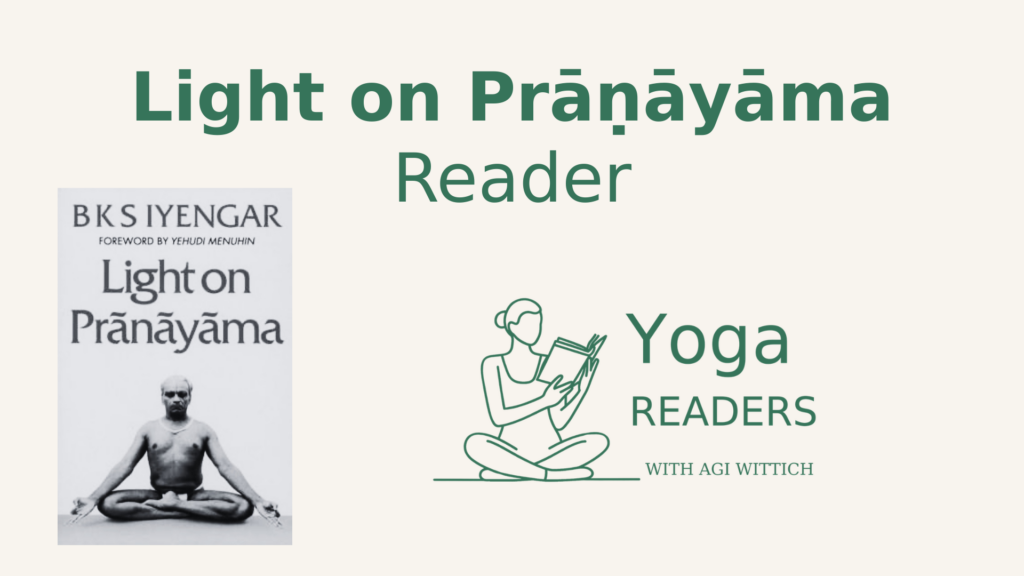
Light on Prāṇāyāma is not a book you read once. You read it in layers. Maybe you start for the technique, then for the philosophy behind the technique, then for the moments when the two refuse to stay separate.

The Light on Prāṇāyāma Reader cuts across Iyengar’s spiral structure and maps it thematically. It starts with tracing pūraka, recaka, and kumbhaka across all thirty chapters, from the first appearance of each in the preparatory sections through to their full elaboration in dhyāna and śavāsana. It holds the text’s tensions open rather than resolving them, and treats Iyengar’s metaphors as instructions rather than illustrations.

Inside:

  • A thematic analysis of the three movements of breath, and what Iyengar says about each physiologically, energetically, and philosophically, and how these threads develop across chapters that are often read in isolation.
  • A technique atlas for all twelve prāṇāyāmas, including  definition, primary action, breath emphasis, bandhas, mental effect, and contraindications in one place.
  • A reading of the metaphors of breath grouped by symbolic field, each with its source citation and an account of what it is teaching the practitioner to do or perceive.
  • Four summary tables: the four phases of breath, all twelve techniques, contraindications, and the three bandhas.

The Reader is designed to be used with the book open alongside it.

Available for 100 ₪ (approximately $35 USD).

This is a digital PDF, delivered immediately upon purchase and yours to download, save, and return to.

PCI Compliant

All materials © 2026 Dr. Agi Wittich. For personal use and teaching preparation.

Agi Wittich PhD

Agi Wittich is a yoga practitioner since two decades, and is a certified Iyengar Yoga teacher. Wittich studied Sanskrit and Tamil at the Hebrew University of Jerusalem, Israel, completing a PhD with a focus on Hinduism, Yoga, and Gender. She has published academic papers exploring topics such as Iyengar yoga and women, the effects of Western media on the image of yoga, and an analysis of the Thirumanthiram yoga text.

Skip to content