
Light on Life: Chapter 3: Vitality – The Energy Body (Breath)
Sunday 21 February 2027 · 8:00 UTC, London (GMT, UTC+0) 8:00 AM, Israel (IST/IDT) 10:00 AM · free on Zoom Our reading of Light
Knowledge, Practice, and Healing
We have sent a 6-digit verification code to your email. Please enter it below to continue.
We have sent a 6-digit verification code to your email. Please enter it below to continue.
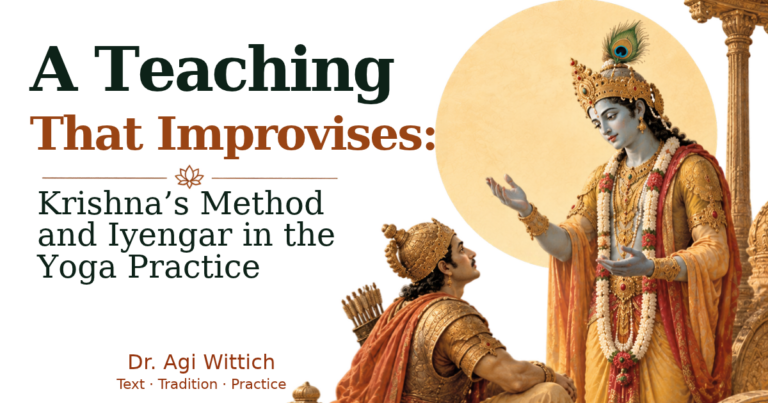
Barbara Stoler Miller described Kṛṣṇa’s method as improvisation:
“Krishna’s teaching is not a fixed doctrine delivered once and for all. It is an improvisation that returns to the same truths in response to Arjuna’s changing condition.”
(Miller, The Bhagavad-Gita, introduction, p. 12)
The same truths return, and each return adapts to Arjuna’s state at that moment. The teaching is a dialogue, and the answer changes because the questioner has changed. Miller’s observation explains the spiral shape that readers of the Bhagavad Gītā notice: familiar verses come back in a different emotional and cognitive setting. In chapter 4, Kṛṣṇa takes up the question of action once again:
“Even the wise are confused about what is action and what is inaction. I shall explain to you that action by knowing which you will be freed from evil.”
(Bhagavad Gītā 4.16)
Two chapters after he first taught it, Kṛṣṇa restates the problem of action, because Arjuna still needs to hear it, and now hears it from a new place.
A text speaks differently when we read it with its commentators, its language, and its living tradition.
This form carries a practical lesson. A teacher who holds to a fixed sequence can give accurate information while missing the condition of the person in front of her. A teacher who improvises on shifting ground can respond to the moment while losing the thread of the teaching. The Bhagavad Gītā holds both requirements together. Kṛṣṇa returns to the same central points, the eternity of the Self, the necessity of action, and the value of action released from attachment, and he adjusts how he offers them each time.
In my own classes, I teach from the logic of Iyengar sequencing more than from a fixed plan. The rules of classical music remain present when a musician plays jazz, and the principles of the sequence remain present as I respond to the room. I respond through adjustments, alterations, and variations. At the start of class, I ask my students how they are. They usually answer honestly, and their answers shape how the class begins. Sometimes the class has to change in the middle. Once, a siren interrupted us: a real threat to life, which none of us could have anticipated. Before we could return to the sequence, we first had to calm down together, and the practice became exactly that.
At the end of the dialogue, Kṛṣṇa hands the teaching back to his student:
“I have declared this knowledge to you in full. Reflect on it fully, then do as you wish.”
(Bhagavad Gītā 18.63)
After eighteen chapters of returning, adapting, and restating, the teacher steps back. The teaching is complete, and the choice belongs to Arjuna. Improvisation serves understanding, and understanding prepares the student to choose for himself.
The opening of the text shows the method at work. Arjuna’s first request receives an answer. His next question, about the person of steady wisdom, receives a different kind of answer, because his condition has shifted:
“What is the description of the man of steady wisdom who is steadfast in concentration? How does he speak, how does he sit, how does he move?”
(Bhagavad Gītā 2.54)
Arjuna began by asking what he must do. Now he asks what a steady person looks like. The question has turned from his own crisis toward a model he might grow into, and Kṛṣṇa’s answer turns with it. The reader follows the same movement and hears the teaching again from a new place.
B.K.S. Iyengar describes his own teaching in similar terms. He explains that students see him as “a stern authoritarian teacher,” and he says that “my strictness has really been a passion for precision so that my students should not suffer from the mistakes and hardship that I had to endure” (Light on Life, p. 70). In another passage he describes adopting a role on purpose: “In teaching it is sometimes necessary for me to act the role of anger. I have to appear ‘mercilessly merciful’ in order to save students from themselves. The anger response is appropriate. But I am not attached to the anger” (p. 135).
I see deep mercy in Iyengar. He was generous with his knowledge and with sharing it. A doctor treating a disease can also seem strict, even ruthless, and Iyengar treated the diseases of body and mind. For my own part, I would describe my teaching as faithful to my values, and full of mercy. I choose gentleness or firmness according to what the class needs. For some students, gentleness increases tamas: it makes them dull, and leaves them less confident. The Gītā describes this quality as heaviness and inertia, which bind through dullness and sleep (14.8). For other students, firmness would feel like violence, like asking too much, or like a failure to understand them. So I navigate in real time.
The ground of Iyengar’s teaching stays constant, and the manner of offering it adapts to the person. In Aṣṭadaḷa Yogamālā, he names that constant ground:
“Know that yama and niyama are present in all the other petals of yoga. A sādhaka cannot achieve anything without practising all the petals of yoga.”
(Iyengar, Aṣṭadaḷa Yogamālā, vol. 2, p. 201)
The ethical ground stays fixed, and the role, the tone, and the words change. The same discipline appears in Kṛṣṇa’s method: a teacher unattached to his own manner, free to take whatever form the student needs.
There is one teaching I return to again and again: be aware of yourself, and keep the inquiry going. Each student hears it differently, so I offer it differently. For some, inquiry slides into self-criticism, and with them I adjust the words: observe, and let the judgment go. For others, I clarify the inquiry itself, the why, and what it means. For others again, I explain what such inquiry gives them. The teaching stays the same, and its form changes with the person, as Kṛṣṇa’s does with Arjuna.
Twelve weeks, chapter by chapter, through the Sanskrit, B.K.S. Iyengar’s writings, and contemporary scholarship. Sundays on Zoom, from April 2027.
Early-bird NIS 1,190 (~$383) until 15 March 2027
[Reserve your place →]
Not ready yet? Receive the next essays by email →
Sunday 21 February 2027 · 8:00 UTC, London (GMT, UTC+0) 8:00 AM, Israel (IST/IDT) 10:00 AM · free on Zoom Our reading of Light
Sunday 7 February 2027 · 8:00 UTC, London (GMT, UTC+0) 8:00 AM, Israel (IST/IDT) 10:00 AM · free on Zoom Our reading of Light
Sunday 24 January 2027 · 8:00 UTC, London (GMT, UTC+0) 8:00 AM, Israel (IST/IDT) 10:00 AM · free on Zoom Our reading of Light

Agi Wittich is a yoga practitioner since two decades, and is a certified Iyengar Yoga teacher. Wittich studied Sanskrit and Tamil at the Hebrew University of Jerusalem, Israel, completing a PhD with a focus on Hinduism, Yoga, and Gender. She has published academic papers exploring topics such as Iyengar yoga and women, the effects of Western media on the image of yoga, and an analysis of the Thirumanthiram yoga text.