A reading that needs care
Readers have sometimes lifted lines from the Bhagavad Gītā, such as 2.19–20 on the one who “thinks he kills,” to argue that an actor carries no responsibility for what he does. The surrounding text points the other way. It distinguishes dharmic action from adharmic action, and it locates the difference in the knowledge and the orientation from which the action proceeds. The fruit remains real. The individual actor simply stops claiming it, and the maintenance of the world stays in view as the larger consequence. Richard H. Davis warns against reading the text selectively:
“The Gītā has been cited both to justify violence and to support non-violence. The text itself refuses to let either reading stand alone; the surrounding verses continually return the reader to the quality and the orientation of the action.”
(Davis, The Bhagavad Gita: A Biography, p. 142)
Iyengar on actions that others follow
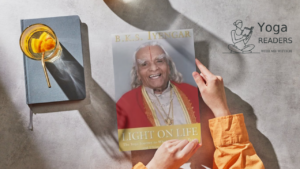
B.K.S. Iyengar’s description of the free person matches verse 3.21 closely. In chapter 7 of Light on Life, he writes: “A yogi’s actions may each be very small, but if each is perfect in its time and place, their cumulative effect is considerable. And because a yogi’s actions are grounded in example, not precept or preaching, there is a snowball effect by which his actions are emulated by others and passed on with compound interest” (p. 231). He adds that “each action is a perfect and discrete module, free of unintended knock-on effects” (p. 231). The Gītā’s “whatever a great man does, that others follow” finds a plain restatement here.
I learned this from my own teacher. Her strength is perseverance. When COVID came, she kept teaching, and adapted quickly to the changing times and needs. When war broke out and we could no longer reach the studio, she adapted again, just as quickly. She did this out of care. She often tells us to practice daily, whatever happens, and she has shown it more than once: while other studios closed, her classes went on. Her example teaches me more than any instruction, and it inspires me still. This is the snowball effect Iyengar describes, carried from teacher to student.
His language of duty returns at the same point. In the lecture “Yoga and Dharma,” which we met in the first essay of this series, he calls yoga “the science of duty of the body, of the consciousness and of the self,” and adds: “It is the wealth of wisdom that shows the right way to live” (Aṣṭadaḷa Yogamālā, vol. 1, pp. 157–158). In the same passage, he quotes the definition of dharma as that which “supports, sustains, upholds those who have fallen.” In Light on Life, the first bank of his river is “the righteous duty that upholds, sustains, and supports our humanity” (p. 237). The duty he describes aims at supporting people who might otherwise fall, and personal results come second.
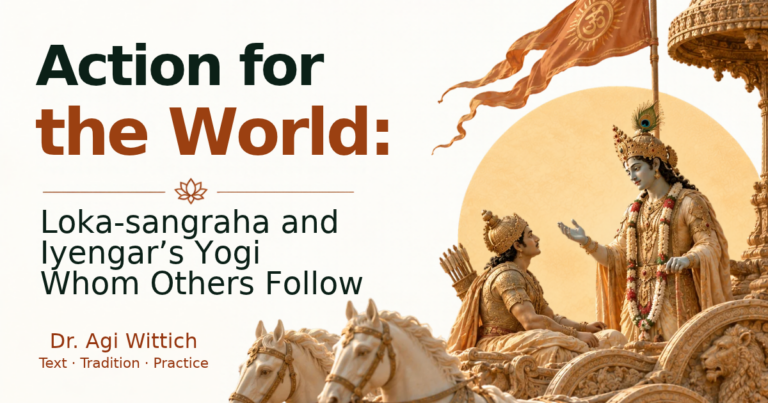
A teacher who goes on teaching without calculating who returns next week still serves the order that the practice sustains. Kṛṣṇa describes exactly this orientation:
“As the unwise act, attached to action, so should the wise act, unattached, desiring the maintenance of the world.”
(Bhagavad Gītā 3.25)
Holding the lineage together
For me, Yoga Readers is my contribution to the worldwide Iyengar community. Together, we read the books of the Iyengar lineage, talk about them, and reflect on them. Reading these texts together is a way of honoring the lineage through its words, and of keeping them alive among practitioners across many countries. In the Gītā’s terms, it is my small share in holding the world together: the world of a tradition, sustained by those who read, practice, and pass it on.