Knowledge, Practice, and Healing

lol yr october 2026 (14)

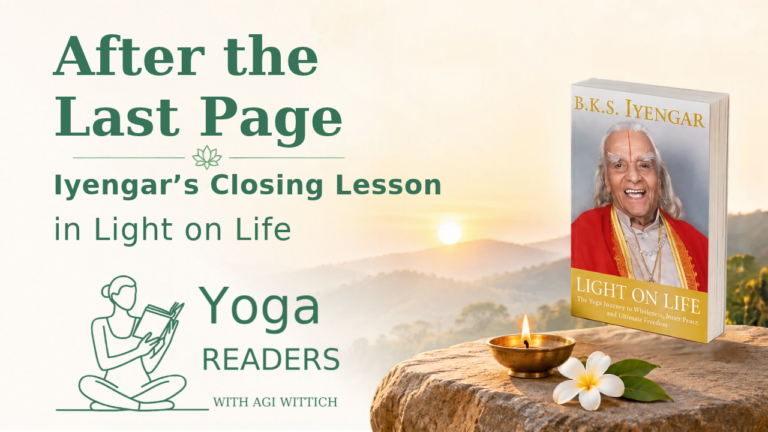
After the Last Page: Iyengar’s Closing Lesson in Light on Life

This essay belongs to our Yoga Readers reading of B.K.S. Iyengar’s Light on Life. We meet free on Zoom from Sunday, 17 January 2027. → Join the reading
A reading cycle has a last Sunday, and a practice goes on. Iyengar knew this, and he built the end of Light on Life around it. This essay gathers the ending of the book and then asks what we do after the last page.

The monk who came down the mountain

Near the close of Chapter 7, Iyengar tells a story about a monk who strove for years and despaired of reaching emancipation. The monk climbed a mountain, ready to find illumination or perish. Near the summit he met an old man coming down, and their eyes locked.

“Near the summit he met an old man coming down the mountain. Their eyes locked, and illumination took place. The monk’s sack dropped to the ground. After moments of blissful silence, the monk looked at the old man and asked, ‘And now what shall I do?’ Without words, the old man indicated the sack, signaled for him to shoulder it again and pointed back down the valley. The monk picked up his pack and went back down the valley. That was illumination on the mountain. What followed was kaivalya down in the valley.” (p. 264)

I read this as Iyengar’s definition of freedom, given in a sacred narrative instead of a formula. Illumination happens, and the sack returns to the shoulder. Then he places himself inside the story: “I too live in the valley, in order to serve the needs of my students” (p. 264). He describes his teaching as his dharma, his enduring duty, and adds a gentle admission: “I have to be content with the divine restlessness that drives me on” (p. 264).

Life is learning

Under the heading “Life Is Learning,” Iyengar steps back from the whole structure of the book. He observes that the book rests on a series of demarcations, the five sheaths, the five elements and their subtle counterparts, and he calls this “a fruitful way to direct the quest toward the exploration of Nature and the discovery of the Soul.” Then he reminds us that “all sheaths and elements, all obvious demarcations, whether between gross or subtle bodies, do not arise at all. All are interwoven in consciousness” (p. 265). The map served the journey, and the territory remains one. He then names his life’s work: “My life’s work has been to show how, even from humble beginnings, this is a path that can lead the dedicated practitioner to the integration of body, mind, and soul” (p. 265).

A TASTE OF YOGA READER'S LIGHT ON LIFE SESSION

While pain isn’t always bad, it’s essential to understand its limits. Guruji’s insights on treating pain without causing injury have been invaluable. My experiences with injuries, though not ideal, have taught me valuable lessons and shaped my practice.

“I have not retired”

His last pages restate the lesson of the tennis player with the voice of an old man: “I have not retired and never shall. I will always keep the inner fire burning. That is why practice (sadhana) cannot be stopped” (p. 266). He adds a preference about death that I find disarming: “I would rather say, ‘Live before you die, so that death is also a lively celebration’” (p. 266). Then comes the line that closes the teaching:

“Let me conclude by quoting the words of the Spanish artist Goya who, in the seventy-eighth year of his life, when he was already deaf and debilitated, said, Aún aprendo, ‘I am still learning.’ It is true for me too. I will never stop learning, and I have tried to share some of these lessons with you. I do pray that my ending will be your beginning. The great rewards and the countless blessings of a life spent following the Inward Journey await you.” (p. 266)

The book ends with a student’s sentence. A master in his ninth decade closes his book with “I am still learning.”

What to do after the last page

I read Light on Life first as a trainee in 2011 and again in 2023. The first reading gave me the structure: the kośas, the practice, the life around the mat. The second reading gave me light when I needed it. I hope that readers of this cycle will come back to the book in the same way. Return to the book often, open it at a different chapter each time, and expect to find knowledge that waited for you to be ready. Iyengar’s last page invites that return. He ends with learning, and the learning continues with each reading.

A closing practice for the week after the cycle ends: choose one sentence from the book and carry it into one ordinary task. Say it quietly before you start your next class, your next meal or your next difficult conversation. Notice what the sentence does to the task.

Questions for reflection

  1. Which sentence from the book do you want to carry into the coming months?
  2. Which tension did Iyengar leave standing that you still hold?
  3. When will you open Light on Life again, and at which chapter?

If this essay spoke to you, join the Yoga Readers community. We read Light on Life chapter by chapter, and new essays reach subscribers before each session. 

Join Yoga Readers

Name(Required)
Email(Required)
Privacy(Required)
✅Is Yoga Readers free?

Yes. Everyone can take part in the live Yoga Readers reading, free of charge. You receive:

  • Live Zoom gatherings, twice a month
  • The reading schedule
  • Short chapter summaries
  • Session summaries: what we explored in each gathering
  • Focus questions and reflection prompts on the website
  • Our WhatsApp and Facebook groups
  • Recordings of the Opening Gathering, the Closing Gathering, and the special conversation with a senior teacher

If you want to read, show up, and think together, you have everything you need.

lol yr october 2026 (11)

Keep the whole cycle

Missed a session, or want to return to one? The Study Pack keeps every session recording and the Study Companion PDF with the themes, summaries, questions, and Sanskrit terms, so you can come back to the cycle for months and years.

Early-bird NIS 249 (~$78) until 20 December 2026

Continue Reading

Agi Wittich Avatar Photo

Agi Wittich PhD

Agi Wittich is a yoga practitioner since two decades, and is a certified Iyengar Yoga teacher. Wittich studied Sanskrit and Tamil at the Hebrew University of Jerusalem, Israel, completing a PhD with a focus on Hinduism, Yoga, and Gender. She has published academic papers exploring topics such as Iyengar yoga and women, the effects of Western media on the image of yoga, and an analysis of the Thirumanthiram yoga text.

Contact

Skip to content