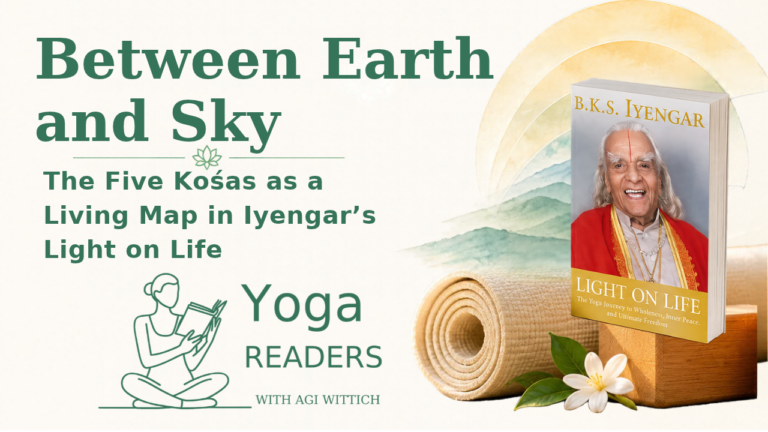
This essay belongs to our Yoga Readers reading of B.K.S. Iyengar’s Light on Life. We meet free on Zoom from Sunday, 17 January 2027. → Join the reading
Most of us meet the five kośas as a picture: an onion, with layers. Iyengar uses the same image in the first chapter. “The kosas are like the layers of an onion or the Russian dolls where one is nested within the other” (p. 4). I like the onion because it invites a practitioner to peel, to look, and to notice which layer she touches on a given morning. This essay follows Iyengar’s own map and then returns it to the mat.
The inward journey starts with a latent core
Chapter 1 begins with a statement about what the practice seeks: “Spiritual realization is the aim that exists in each one of us to seek our divine core. That core, though never absent from anyone, remains latent within us. It is not an outward quest for a Holy Grail that lies beyond, but an Inward Journey to allow the inner core to reveal itself” (p. 3). The key word is latent. If the core stays latent, the work consists of uncovering. We remove haste, dullness and the habit of living only at the skin, and the core shows itself.
Five sheaths, one person
The word kośa means “sheath” or “covering.” Iyengar lists five, from the outside inward. The annamaya kośa (anna, “food”) is the anatomical body. The prāṇamaya kośa (prāṇa, “breath, vital energy”) is the energetic body. The manomaya kośa (manas, “mind”) is the mental body. The vijñānamaya kośa (vijñāna, “discernment, wisdom”) is the intellectual body. The ānandamaya kośa (ānanda, “bliss”) is the blissful body, which he also calls the soul body.
What matters most is how the layers relate. Iyengar writes:
“When these bodies or sheaths are misaligned or clash with one another, we inevitably encounter the alienation and fragmentation that so trouble our world. When, on the other hand, we are able to bring the various sheaths of our body into alignment and harmony with one another, the fragmentation disappears, integration is achieved, and unity is established.” (p. 4)
This is a practical diagnosis. A tired body with a performing mind, a calm breath next to a harsh thought, a joy on the mat that vanishes by the kitchen sink: each case describes two sheaths that have stopped speaking to each other. Iyengar draws the conclusion a few pages later: “Do not forget the word align. It is through the alignment of my body that I discovered the alignment of my mind, self, and intelligence” (p. 8).
A TASTE OF YOGA READER'S LIGHT ON LIFE SESSION
These moments of clarity, what we call “aha” moments, come unexpectedly. Tradition teaches that deep meditation brings them about, but truly, they can arise at any time, in any place.
Where I feel the layers meet
In my own practice, the layers announce themselves at different seams. In prāṇāyāma, I notice most easily the shift between the prāṇamaya and the manomaya kośa: the breath steadies, and the mind follows it a moment later. In āsana, the meeting point lies between the annamaya and the prāṇamaya kośa: the shape of the body changes, and the breath responds. The two outer seams feel familiar because the body and the breath give quick feedback.
The two innermost layers ask more of me. The vijñānamaya and the ānandamaya kośa stay the hardest to sense. Iyengar describes what the experience can look like when the outer layers settle: “I am practicing asana but at a level where the quality is meditative. The totality of being, from core to skin, is experienced. Mind is unruffled, intelligence is awake in heart rather than in head, self is quiescent, and conscious life is in every cell of the body” (p. 182). He gives the vijñānamaya kośa a working task earlier in the book: “The form of each asana needs to be reflected to the wisdom body (vijnanamaya kosa) for readjustment and realignment” (p. 39). In practice this means that the intelligence receives the pose, evaluates it, and sends back a correction. Hardest to feel still means present. This layer listens when the others quiet down.
Between earth and sky
Iyengar frames the entire map with two realities. As he puts it, “we human beings live between the two realities of earth and sky” (p. 6). The earth belongs to prakṛti, nature, which includes the body and its five elements. The sky belongs to puruṣa, the soul, the witness. He puts the relationship plainly:
“The whole practice of yoga is concerned with exploring the relationship between Prakrti and Purusa, between Nature and Soul. It is about, to return to our original image, learning to live between the earth and the sky. That is the human predicament, our joy and our woe, our salvation or our downfall. Nature and Soul are mingled together. Some would say they are married.” (p. 9)
If marriage is the right image, the five kośas describe the rooms of the marital home, and the practice keeps the conversation going. Iyengar says as much: “It is through the correct practice of asana and pranayama and the other petals of yoga that the practitioner (sadhaka) experiences the communication and connection between them” (p. 9).
Questions for reflection
- Where do you feel the shift between two kośas most clearly, in āsana, in prāṇāyāma, or in a conversation?
- Which layer feels hardest to sense, and what helps you listen to it?
- What image do you use when you explain the kośas to a friend?
If this essay spoke to you, join the Yoga Readers community. We read Light on Life chapter by chapter, and new essays reach subscribers before each session.
Join Yoga Readers
- The Zoom link and a reminder before every session
- The reading schedule and chapter summaries
- Focus questions and reflection prompts for each session
- The Yoga Readers Guide: how to read along and get the most from the journey
✅Is Yoga Readers free?
Yes. Everyone can take part in the live Yoga Readers reading, free of charge. You receive:
- Live Zoom gatherings, twice a month
- The reading schedule
- Short chapter summaries
- Session summaries: what we explored in each gathering
- Focus questions and reflection prompts on the website
- Our WhatsApp and Facebook groups
- Recordings of the Opening Gathering, the Closing Gathering, and the special conversation with a senior teacher
If you want to read, show up, and think together, you have everything you need.
Keep the whole cycle
Missed a session, or want to return to one? The Study Pack keeps every session recording and the Study Companion PDF with the themes, summaries, questions, and Sanskrit terms, so you can come back to the cycle for months and years.
Early-bird NIS 249 (~$78) until 20 December 2026