

Yoga Readers: Light on Prāṇāyāma
A global reading journey with B.K.S. Iyengar’s classic on the yogic art of breathing January – May 2026 on Sundays 8am UTC (Coordinated Universal
From Book Session: Special Session with Lois Steinberg
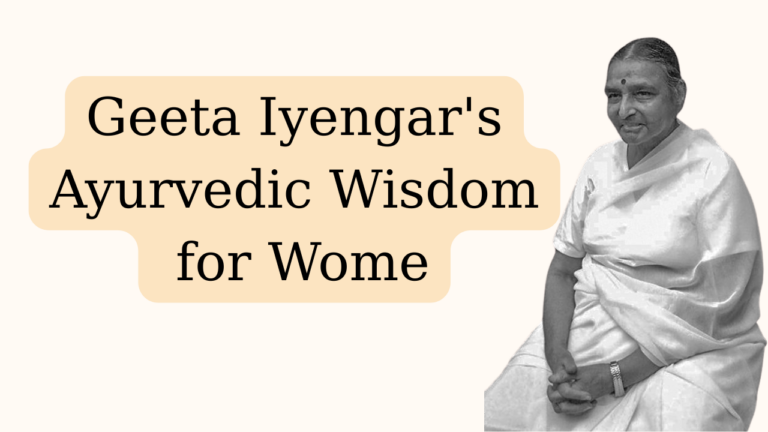
In her seminal work “Yoga – A Gem for Women,” Geeta S. Iyengar beautifully integrates the principles of Ayurveda with the practice of yoga. As the daughter of yoga master B.K.S. Iyengar and a renowned teacher in her own right, Geeta’s approach to women’s health is deeply rooted in traditional Ayurvedic understanding while being accessible to modern practitioners.
Geeta Iyengar begins with a fundamental Ayurvedic principle – that health is not merely the absence of disease but a state of complete balance. She quotes the Upanisads (उपनिषद् upaniṣad), ancient Sanskrit texts containing philosophical concepts and teachings:
“Health confers longevity, firmness and strength; by this the entire terrestrial sphere will become affluent fully.”
She further emphasizes that health is the foundation for all human pursuits by quoting the Caraka Samhita (चरक संहिता caraka saṃhitā), the foundational text of Ayurveda:
“dharmartha kdma moksanam arogyam mulam uttamam”
This Sanskrit verse establishes that “The fundamental requirement of the body is good health in order to attain the four objectives of human existence, namely, acquisition of religious merits (धर्म dharma – righteous duty), wealth for living in comfort and generousness (अर्थ artha – prosperity), gratification of permissible pleasures and fulfillment of desires (काम kāma – pleasure), and lastly, the endeavour to obtain liberation from the shackles of mundane cycles of births and deaths (मोक्ष mokṣa – spiritual liberation).”
Iyengar elaborates on the classic Ayurvedic understanding of the three humours or doshas (दोष doṣa):
“The science of Ayurveda (आयुर्वेद āyurveda – ‘knowledge of life’) has categorised the physiological functions of the body as falling under three heads, namely, Clana (चलन calana – movement) – Movement, Pacana (पचन pacana – digestion) – Digestion or assimilation, and Lepana (लेपन lepana – coating/illumination) – Respiration or illumination, which correspond respectively to the three humours of Vata (वात vāta – wind) – Wind, Pitta (पित्त pitta – bile) – Bile, and Slesma (श्लेष्म śleṣma, also known as कफ kapha) – Phlegm.”
This tripartite framework is central to Ayurvedic diagnosis and treatment. Iyengar explains that these humours “maintain a harmonious ratio of their own when the body is in a good state of health.”
Expanding further on the Ayurvedic concept of health, Iyengar provides a comprehensive definition:
“Health is defined as equilibrium among five factors: (i) the dosas – the humours; (ii) the dhatus (धातु dhātu – tissue layer) – seven juicy secretions from the ingredients of the body; (iii) Agni (अग्नि agni – digestive fire), i.e., proper functioning of digestion and elimination of waste matter, which is called the metabolism of the body; (iv) clarity or purity of the senses; and (v) tranquillity and peace of the mind.”
This definition beautifully encompasses both physical and mental aspects of wellness, demonstrating the holistic nature of Ayurvedic thought.
Iyengar’s description of disease aligns perfectly with Ayurvedic principles of imbalance:
“Any deficiency or excess in the normal quantity of the dosas (humours) or the dhatus (ingredients), or any obstruction in their flow brings about imbalance and results in indisposition causing disease.”
She elaborates on the system of channels called srotas (स्रोतस् srotas – channels/passages) through which substances flow in the body:
“According to Ayurveda, the body has thirteen srotas or vessels to carry various substances throughout the body. They are pranavaha (प्राणवह prāṇavaha – channels carrying life force) – breath ducts, trachea, etc.; annavaha (अन्नवह annavaha – food-carrying channels) – food pipe, oesophagus, etc.; udakavaha (उदकवह udakavaha – water-carrying channels) – water duct; rasavaha (रसवह rasavaha – channels carrying plasma) – juice such as bile and pancreatic juice; raktavaha (रक्तवह raktavaha – blood-carrying channels) – blood vessels; mamsavaha (मांसवह māṃsavaha – channels related to muscle tissue) – flesh; medovaha (मेदोवह medovaha – fat-carrying channels) – fat; asthivaha (अस्थिवह asthivaha – channels related to bone tissue) – bones; majjavaha (मज्जावह majjāvaha – channels related to bone marrow) – marrow; sukravaha (शुक्रवह śukravaha – channels carrying reproductive fluid) – seminal duct; sakrdvaha (शकृद्वह śakṛdvaha – channels for waste matter) – waste matter, faeces; etc.; mutravaha (मूत्रवह mūtravaha – urine-carrying channels) – urinary duct; and svedovaha (स्वेदोवह svedovaha – sweat-carrying channels) – sweat pores.”
Moving beyond physical health, Iyengar introduces the concept of the three gunas (गुण guṇa – quality or attribute) that affect mental health:
“As the fluctuations in the physical body are caused by the humours, the mental fluctuations are caused by the rajas (रजस् rajas – activity, passion) and tamo gunas (तमस् tamas – darkness, inertia) overshadowing the sattva guna (सत्त्व sattva – purity, harmony). Rajas is one of the constituent qualities causing the activities seen in human beings, in the form of passions and emotions. Tamas is the other constituent quality which causes inertia or inaction which leads one into darkness such as grief sorrow, ignorance, etc. When the rajas and the tamo gunas dominate or cover the sattva guna, the quality of goodness or purity, the mind becomes the abode of disease.”
This elegant parallel between physical and mental health demonstrates the interconnectedness of body and mind in Ayurvedic thought.
Throughout her text, Iyengar emphasizes how yoga serves as a practical method for restoring and maintaining the balance that Ayurveda describes as health:
“Practice of Yoga brings a perfect balance in body and mind. It makes the body healthy to cooperate with the mind, so that steadiness, composure, and firmness are developed.”
She describes how yoga affects the entire system:
“The digestive system is one of the most important systems on which the health of the entire body depends. Its malfunctioning is the root of many diseases and asanas (आसन āsana – posture or seat) are an infallible help in alleviating them.”
Particularly relevant to women, Iyengar applies Ayurvedic principles to the three major transitions in a woman’s life: menstruation, pregnancy, and menopause. She notes how yoga helps to balance hormones and maintain equilibrium during these transitions:
“At around 40 to 50 years, women experience disturbance in the menstrual cycle… As the ovaries stop functioning, the other glands, namely, the thyroids and the adrenals, become hyperactive and there is an imbalance of hormones.”
She emphasizes how yoga can help restore balance during menopause:
“At this juncture, practice of Yoga asanas is extremely beneficial, as it calms the nervous system and brings equipoise (समत्व samatva – evenness, equanimity).”
Geeta Iyengar’s integration of Ayurvedic principles with yoga practice offers women a comprehensive approach to health throughout their lifecycle. By understanding the fundamental concepts of balance—whether between the dosas in the body or the gunas in the mind—women can use yoga as a powerful tool for maintaining and restoring health.
Through her work, Iyengar has created a bridge between ancient wisdom and modern practice, making the profound insights of Ayurveda accessible to women seeking a holistic approach to wellness. Her text reminds us that the ultimate aim of both yoga and Ayurveda is to achieve harmony (सामञ्जस्य sāmañjasya) of body, mind, and spirit.
A global reading journey with B.K.S. Iyengar’s classic on the yogic art of breathing January – May 2026 on Sundays 8am UTC (Coordinated Universal
Date and Time: January 18, 2026 8am UTC (Coordinated Universal Time) In this new Yoga Readers cycle we will be reading B.K.S. Iyengar’s Light on
Thank you for registering for Threads in Patanjali’s Wisdom online course with Dr. Agi Wittich This page contains everything you need for eight weeks

Agi Wittich is a yoga practitioner since two decades, and is a certified Iyengar Yoga teacher. Wittich studied Sanskrit and Tamil at the Hebrew University of Jerusalem, Israel, completing a PhD with a focus on Hinduism, Yoga, and Gender. She has published academic papers exploring topics such as Iyengar yoga and women, the effects of Western media on the image of yoga, and an analysis of the Thirumanthiram yoga text.