Private Iyengar Yoga classes
Private Iyengar Yoga sessions offer an opportunity for focused, individualized work, tailored precisely to your needs, physical condition, and stage of practice. In
At the beginning of Light on Prāṇāyāma, B.K.S. Iyengar mentions, almost in passing, the concept of Hiraṇyagarbha. He does not stop to explain it, trace its sources, or devote a systematic discussion to it. As with many such references in his writing, the modern reader — especially one not immersed in the Indic textual world — may feel that Iyengar is pointing toward an entire universe that remains outside the frame. In my view, for practitioners and teachers who wish to deepen in the path of yoga, understanding Hiraṇyagarbha is essential for grasping the pedagogical rationale and the spirit of learning within the Iyengar tradition — a tradition that seeks to align the “known” physical body of the individual with an “unknown” cosmic source.
This article was written out of that gap. My motivation is not mythological but hermeneutic: to clarify Iyengar’s incidental remarks and place them within the cultural–spiritual context they invoke. I am not asking, “What is Hiraṇyagarbha in general?” but a more precise question: why does Iyengar choose to open a book on prāṇāyāma with a reference to an ancient cosmological concept, and what does that choice reveal about the kind of practice he is presenting?
The first, basic (yet necessary) question is: what is Hiraṇyagarbha?
The Philosophical Identity: The Golden Embryo
The term derives from the Sanskrit words hiraṇya (“golden”) and garbha (“embryo,” “egg,” or “womb”). In Vedic and Upaniṣadic literature, the “Golden Embryo” or “Golden Womb” serves as an image for the primordial principle of emergence: a cosmic state of concentrated potential, life and consciousness not yet differentiated into the multiplicity of forms. It is not merely a mythological figure, but an attempt to name the threshold between the unmanifest and the manifest: a nucleus, a convergence, an origin that contains everything. In the broader framework of Hindu thought and Sāṁkhya philosophy, Hiraṇyagarbha may be understood as the first manifestation of Brahman — the primordial “seed” of nature from which material phenomena unfold.
To understand what Iyengar is activating when he invokes Hiraṇyagarbha, it is helpful to return to its most explicit Vedic appearance in the Hiraṇyagarbha Sūkta of the Rigveda (10.121). There, Hiraṇyagarbha is described as the one who “arose in the beginning,” the “sole lord of all that is born,” who “holds earth and heaven,” while almost every verse circles back to the question: “To which god shall we offer our oblation?” This refrain signals not only devotional reverence but also philosophical searching — an effort to name the principle of origin that precedes multiplicity and form.
According to yogic tradition and the Yājñavalkya Smṛti, the creator (Brahmā) as Hiraṇyagarbha is regarded as the primordial articulator of the system of yoga, oriented toward bodily health, mastery of consciousness, and the attainment of peace. While the sage Patañjali is often treated as the “father of yoga” because he codified yogic wisdom into the Yoga Sūtra, Iyengar reminds us that Patañjali was an editor rather than an inventor. The wisdom itself is framed as eternal, flowing from Hiraṇyagarbha into human transmission.
For a broader context on Yoga’s philosophical roots, check out my recorded course “Threads of Patañjali’s Wisdom” on the Yoga Sūtras, that connects these ideas to practice and modern understanding.
Hiraṇyagarbha and the Vital Energy (Prāṇa)
The more pressing question in our context, however, is what cosmology has to do with prāṇāyāma. My suggestion is that Iyengar opens his discussion of breath from within a cosmological horizon, positioning prāṇāyāma as work with prāṇa — life-force itself — which in Vedic and philosophical traditions carries a cosmic dimension. This differs from approaching prāṇāyāma primarily as a technical repertoire of breathing exercises or as a purely respiratory method. Iyengar’s reference to Hiraṇyagarbha implies that breath is not only physiological function, but a movement that participates in a principle of creation: contraction, organization, and the emergence of order out of potential.
The connection between Hiraṇyagarbha and the practitioner becomes clearest through prāṇa. Iyengar defines prāṇa as an energy that permeates the universe at every level — physical, mental, and cosmic. In the Upaniṣads, prāṇa is associated with the true Self (Ātman): living beings are “born through it and live by it,” and when they depart, individual breath dissolves back into cosmic breath. Through prāṇāyāma, the practitioner consciously connects to the source implied by Hiraṇyagarbha, expanding the cosmic vitality of the “Golden Embryo” within the practitioner’s own nervous system.
At this point, a further question arises: is Iyengar making a historical claim, grounding yoga in an ancient hymn, or is he proposing something else? It seems that the intention is not historical but metaphysical. Hiraṇyagarbha is not the “first teacher” in a biographical sense, but a principle indicating that yoga does not begin with the isolated individual, but with a structure of being. The yogin does not “invent” states of consciousness; the yogin learns to align with a deeper order already present in reality.
From here we arrive at the practical question that may already be forming for many readers: what changes in our understanding of prāṇāyāma if we read it through Hiraṇyagarbha? Seen from this perspective, prāṇāyāma ceases to be only a practice of regulating breath or modulating the nervous system. It becomes a subtle engagement with the conditions by which consciousness itself emerges. Pause, restraint, listening, and precision are not merely technical rules; they express a fundamental movement — returning from dispersion to the nucleus. In this sense, practice recreates in the body what cosmology describes in terms of creation.
This article, then, is not an attempt to “explain a myth,” but to illuminate Iyengar’s interpretive choice. His passing remark is not a cultural ornament; it is an indication of depth. Prāṇāyāma, as Iyengar understands it, is rooted in a view where breath is connected to the structure of existence, not only to the respiratory system. Understanding this context does not simply add information — it changes how we read the text and the quality of attention we bring to practice.
Ultimately, the question that accompanies the reading is whether we practice to improve function, or to attune ourselves to something more fundamental. For Iyengar, breath becomes a gateway into a wider inquiry about the source of life and consciousness. In that sense, his brief reference to Hiraṇyagarbha functions as a key: a key to a deeper reading of the book, and to a practice oriented not only toward what we do, but toward what life itself — within the tradition — is understood to have been doing since the beginning.
The ethos of Iyengar study — marked by discipline, precision, and a “patient and careful effort” — is firmly rooted in this philosophical orientation. Iyengar assumes we must first know the “known” (the body) before we can investigate the “unknown” (Ātman). “First,” as he frames it, yoga concerns health, strength, and sovereignty over the body; then it removes the veil of separation between body and mind; finally it leads the sādhaka toward peace and absolute purity. When we stand in Tāḍāsana or sit for prāṇāyāma, we are not merely performing a technique: we are participating in a lineage of higher knowledge (mahāvidyā). Hiraṇyagarbha names the potential carried within us — the seed of an exalted flame.
The Journey from Known to Unknown
The culture of an Iyengar classroom—characterized by discipline, precision, and “patient and cautious effort”—is rooted in this philosophical descent. Iyengar posits that we must first know the “known” (the body) before exploring the “unknown” (Ātmā).
“First, Yoga deals with health, strength and conquest of the body. Next, it lifts the veil of difference between the body and the mind. Lastly, it leads the sādhaka to peace and unalloyed purity”.
This systematic unravelling—proceeding from the skin to the nerves, from the senses to the mind, and finally from consciousness to the Self—is the practical method of returning to the primordial state of Hiraṇyagarbha.
Interested in how these principles play out in real life and practice? Listen to the recorded lecture “How Iyengar Yoga Becomes an Anchor in Times of Crisis” — a session I gave on embodied resilience and spiritual grounding.
When we stand in Tāḍāsana or sit for Prāṇāyāma, we are not just performing a technique; we are participating in a lineage of “exalted knowledge” (mahā vidyā)14. Hiraṇyagarbha represents the potentiality within us—the seed of the Divine Flame. As Iyengar beautifully concludes:
“When he realises that he is a spark of the Divine Flame burning throughout the universe, then all his past impressions (saṃskāras) are burnt out, and he becomes enlightened”
Support my research and teaching — Buy Agi a Chai ☕
Deepen your study — explore the Light on Prāṇāyāma study pack
Continue learning with community and discussion — join Yoga Readers
The Light on Prāṇāyāma – Study Pack is meant for dedicated students and teachers who want everything in one place.
This makes sense if you join late and want to catch up thoroughly, like to re-watch and take notes at your own pace, and want a compact resource you can revisit over months and years.
The Light on Prāṇāyāma – Study Pack includes:
Buying recordings or the Study Pack is one way to support the time and research that goes into Yoga Readers – and to receive a resource designed for long-term study.

I am a scholar of yoga and a certified Iyengar Yoga teacher with over two decades of dedicated practice and teaching experience. With a Ph.D. in Comparative Religion from the Hebrew University of Jerusalem, focusing on women in Iyengar Yoga, I bridge academic research and practical yoga instruction. My journey includes extensive study at the Ramamani Iyengar Memorial Yoga Institute in Pune, India, and training with renowned international teachers. Currently teaching in Jerusalem and serving as a trauma-informed yoga teacher with NATAL – Israel Trauma and Resiliency Center, I founded Yoga Readers to share the profound wisdom of yogic texts with practitioners worldwide.
By combining my academic background in Indian philosophy and Sanskrit with practical teaching experience, I strive to make the deep wisdom of yoga accessible and meaningful to contemporary practitioners, creating a space where physical practice meets philosophical understanding.
Private Iyengar Yoga sessions offer an opportunity for focused, individualized work, tailored precisely to your needs, physical condition, and stage of practice. In
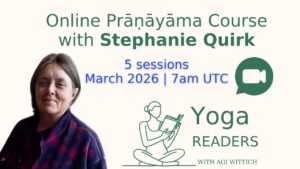
A special offering for Light on Prāṇāyāma readers We’re happy to offer this 5-session online prāṇāyāma course with senior Iyengar teacher Stephanie Quirk at
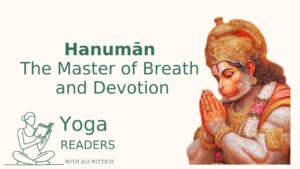
At the opening of Light on Prāṇāyāma, B.K.S. Iyengar invokes Hanumān [हनुमान्]. The reference is brief, almost passing, yet it is not incidental. Iyengar
Agi Wittich is a yoga practitioner since two decades, and is a certified Iyengar Yoga teacher. Wittich studied Sanskrit and Tamil at the Hebrew University of Jerusalem, Israel, completing a PhD with a focus on Hinduism, Yoga, and Gender. She has published academic papers exploring topics such as Iyengar yoga and women, the effects of Western media on the image of yoga, and an analysis of the Thirumanthiram yoga text.