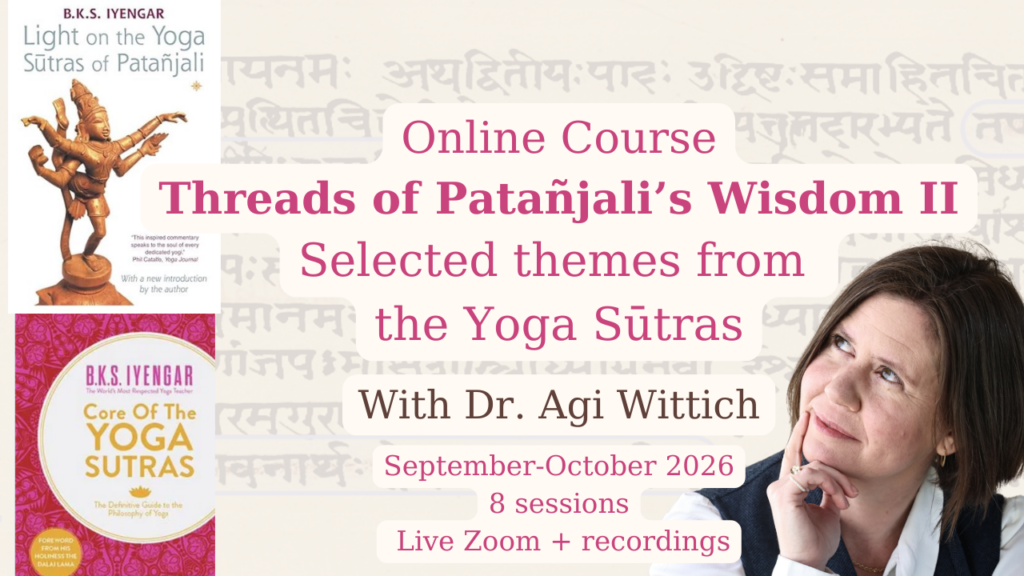
Sundays 6:00–7:00am UTC | September–October 2026 | 8 sessions | Live Zoom + recordings
A course of advanced themes from the Yoga Sūtras with Dr. Agi Wittich
For graduates of Threads in Patañjali’s Wisdom — and for committed students ready to go further into the philosophical architecture of the Sūtras.
The first course laid the foundation: the mind, practice and detachment, āsana as a path to samādhi, breath, ethics, and the relationship between seer and seen. This course picks up from there, moving into the mechanics of transformation itself — Kriya Yoga, Īśvara, tapas, the guṇas, the inner limbs from pratyāhāra to samyama, conditioning and its undoing, and the culmination in kaivalya.
Each session pairs original Sanskrit with Iyengar’s commentary and embodied practice, with key terms still carefully explained — so returning students never need to have memorized the first course to keep up.
How This Course Builds on the First
Threads in Patañjali’s Wisdom | Advanced Threads in Patañjali’s Wisdom | |
Focus | Foundations: mind, practice, āsana, breath, ethics, the seer | Mechanics of transformation: action, devotion, discipline, conditioning, powers, liberation |
Entry point | No prior knowledge needed | Builds on the first course’s vocabulary and framework |
Core question | What is yoga, and how do I begin? | How does real change actually happen — and how do I navigate its subtler challenges? |
Themes already covered in the first course — citta-vṛtti-nirodhaḥ, abhyāsa and vairāgya, āsana as meditation, the kleśas, and viveka — are assumed as shared ground here, not retaught. This course instead opens new territory: Kriya Yoga, Īśvara, tapas, the guṇas, pratyāhāra and samyama, karma and saṃskāras, vibhūtis, and kaivalya.
Course Outline
Session 1: Kriyā Yoga – The Yoga of Action (II.1–II.2) Tapas, svādhyāya, and īśvara-praṇidhāna as one integrated path of purification.
Session 2: Īśvara – The Special Puruṣa and Devotion (I.23–I.28) Grace through surrender to untouched pure consciousness.
Session 3: Tapas – The Fire of Discipline (II.1, II.32, II.43) Joyful austerity that purifies body and senses without self-harm.
Session 4: The Three Guṇas & Pariṇāma (II.18 + III.9–III.11) How qualities and transformation shape mind, body, and habits.
Session 5: Pratyāhāra & Saṁyama (II.54–II.55 + III.1–III.4) The inner turn and the technology of deep absorption.
Session 6: Citta Vikṣepas & Conditioning (I.30–I.32 + II.12–II.14) Overcoming mental obstacles and recurring patterns.
Session 7: Vibhūtis – Powers as Byproducts (III.16–III.37 + II.35–II.45) Selected concrete examples of how ethical practice gives rise to powers.
Session 8: Samādhi & Kaivalya (IV.25–IV.26 + IV.29–IV.34) Living freedom and the completion of the path.
Each session is supported by recommended readings from Iyengar’s commentaries and contemporary scholarship.

Please log in or register before paying.
Earlybird 1100₪(~$367) 1450₪(~$479)/ in 1 installment
Please log in or register before paying.
Earlybird 1100₪(~$367) 1450₪(~$479)/ in 3 installment
Course Outline
Session 1: Kriyā Yoga – The Yoga of Action
Tapas, svādhyāya, and īśvara-praṇidhāna as one integrated path of purification. Kriyā-yoga is not a warm-up for the real practice — it is the accessible vehicle Patañjali offers the mind that is not yet still. The session explores how these three practices work together to thin the kleśas through sustainable daily discipline.
Yoga Sūtras: II.1–II.2
Session 2: Īśvara – The Special Puruṣa and Devotion
Īśvara as untouched pure consciousness; īśvara-praṇidhāna as grace amid effort; oṁ as the sonic vehicle of surrender. The quiet word “vā” (“or”) opens a second door into the same stillness. The session explores what it means to practice surrender without collapsing into passivity or bypassing personal responsibility.
Yoga Sūtras: I.23–I.26 + I.27–I.28
Session 3: Tapas – The Fire of Discipline
Tapas appears first as one limb of kriyā-yoga, then as a formal niyama, and finally as the practice whose fruit is perfection of body and senses. The session distinguishes joyful, purifying heat that produces inner radiance from self-punishing austerity or modern hustle culture. It shows why ahiṃsā itself cannot be properly understood without this inward hardness turned carefully toward one’s own habits.
Yoga Sūtras: II.1 (reminder) + II.32 + II.43
Session 4: The Three Guṇas & Pariṇāma – Qualities and Transformation
Sattva, rajas, and tamas as the actual building material of mind, body, and the world; pariṇāma as their only permanent behaviour. The session asks what, underneath ceaseless change, does not change at all, and how noticing the guṇas in daily energy, mood, and habit patterns becomes a practical form of viveka.
Yoga Sūtras: II.18 + III.9–III.11
Session 5: Pratyāhāra & Saṁyama – The Inner Turn and Integrated Technology
Pratyāhāra as the hinge limb that turns us from the world of objects toward the world within; the fusion of dhāraṇā, dhyāna, and samādhi into one continuous act called saṁyama. The session explores the felt difference between concentrating on something and becoming absorbed in it, especially in an age of constant distraction.
Yoga Sūtras: II.54–II.55 + III.1–III.4
Session 6: Citta Vikṣepas & Conditioning – Overcoming Mental Obstacles
The nine disturbances that scatter attention in the present moment and the deeper residue of karma, saṃskāra, and vāsanā. A single steady focal point is strong enough to outlast all nine because it addresses the scattering itself. The session holds the “razor edge” of sādhana: how even success can become the next obstacle if the fruits are not released.
Yoga Sūtras: I.30–I.32 + II.12–II.14
Session 7: Vibhūtis – Powers as Byproducts, Grounded in Ethics
Vibhūtis arise as natural byproducts of saṁyama, yet Patañjali places them directly beside the results of yama and niyama. A power without an ethical foundation is a hazard; an ethical foundation without any fruit would be a strange kind of practice. The session examines selected concrete examples of powers alongside the everyday fruits of ethical consistency.
Yoga Sūtras: Selected 3–4 concrete examples from III.16–III.37 + II.35–II.39 (or II.40–II.45)
Session 8: Samādhi & Kaivalya – Integrated Freedom and Fruits
Dharma-megha samādhi as the rain-cloud of virtue that pours without being summoned drop by drop; kaivalya as the completion of viveka and the establishment of consciousness in its own nature. Kaivalya is not an exit from the world but freedom while fully engaged in it. Looking back across the course, the closing question is which single thread feels most like your own to keep walking.
Yoga Sūtras: IV.25–IV.26 + IV.29–IV.31 + IV.34
What You'll Gain
- A deeper, more embodied understanding of how real transformation unfolds through sustained practice — going far beyond the foundational ideas of the first course.
- Practical tools to work consciously with conditioning, habit patterns, and mental obstacles (citta-vikṣepas, saṃskāras, and vāsanās).
- Clear insight into the relationship between ethical living (yama and niyama) and the arising of inner powers and clarity.
- A grounded, non-mystified understanding of advanced practices such as saṁyama and their fruits.
- Direct engagement with the final stages of the path — dharma-megha samādhi and kaivalya — through both text and lived experience.
- Continued connection with a committed community of fellow students walking the same deep inquiry.
FAQ
Do I need to have taken the first course? Yes. This is an advanced course that builds directly on the vocabulary, themes, and pace of Threads in Patañjali’s Wisdom. If you haven’t taken the first course but have done substantial prior study of the Yoga Sūtras (especially with Iyengar commentary), please reach out. I’m happy to discuss whether this course would be a good fit for you.
Will the sessions be recorded? Yes. All sessions are recorded and the recordings are available to all participants throughout the course and for a period afterward.
Is this course only for yoga teachers? No. It is open to both dedicated practitioners and teachers who have a strong Iyengar background and prior experience studying the Sūtras. The course is designed for serious students who want to go deeper, whether they teach or not.
How advanced is this course? This is the second level in the series. We move at a slower, more contemplative pace than many academic courses, but we work with more subtle and complex material than the first course. The focus is on depth and integration rather than covering large amounts of text.
Is there required reading between sessions? There is recommended reading, but it is kept reasonable. The emphasis of the course is on embodied understanding and discussion rather than heavy academic preparation.
What if I miss a session? All sessions are recorded, so you can catch up easily. Many participants appreciate the recordings for deeper listening and integration.
Why this version is better:
- More reassuring and professional
- Addresses real concerns people have (level, time commitment, recordings, prerequisites)
- Sounds warm and thoughtful (your voice)
- Helps convert hesitant people


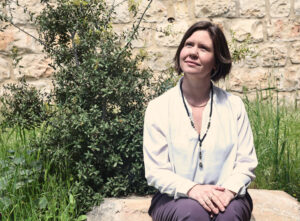
I’m Dr. Agi Wittich — a scholar of yoga philosophy and gender, a certified Iyengar Yoga teacher (CIYT), and founder of the Yoga Readers community. My work lives at the intersection of academic rigor and embodied practice, drawn from two decades of teaching and personal study.
I hold a PhD in Comparative Religion from the Hebrew University of Jerusalem, where my doctoral research examined women-oriented Iyengar Yoga through interviews with senior teachers worldwide, including members of the Iyengar family. My academic work has been published in peer-reviewed journals, and I continue to write, present, and teach at the intersection of Sanskrit textual study and lived practice.
As a teacher, I’ve led therapeutic and trauma-sensitive yoga programs, taught Yoga Sūtra courses for certifying Iyengar teachers, and built Yoga Readers into a global community of over 1,700 practitioners engaged in close reading of classical yoga texts. I bring the same approach to this course: careful textual study, grounded in Iyengar’s embodied teaching, made accessible without ever being diluted.