Knowledge, Practice, and Healing

Light on Life: Chapter 3: Vitality – The Energy Body (Breath)

Live Session: Sunday, November 8 2026 |  08:00 UTC

Our reading of Light on Life continues with Chapter 3: Vitality.

The Zoom link to this session is sent via our Newsletter, Whats’app & Facebook group

Reading Summary

After beginning with the physical body, Light on Life moves to the second layer of our being: prāamaya kośa, the energy body.

In this chapter, Iyengar explores prāa, the vital force that animates life, and prāāyāma, the practice through which that energy is consciously extended, regulated and directed. Breath is central to this work, but prāṇa is not simply another word for breath. Iyengar describes it as a vital energy that operates through the physical, mental and intellectual dimensions of our being and connects individual life with something larger.

Importantly, Iyengar does not separate this work from the stability cultivated through āsana. He writes candidly about his own early difficulties with prāṇāyāma and emphasizes the need to prepare the body before attempting to work intensively with energy. The physical body must be able to receive and contain what the practice generates.

One of the striking images in this chapter is that of hydroelectric power. Just as water can be dammed, contained and channelled in order to generate electricity, the flow of breath can be regulated so that its energy is no longer simply dispersed. Iyengar also describes the meeting of fire and water, mind and body, as essential to the work of prāṇāyāma.

The chapter therefore takes us one layer further into the journey begun in Chapter 1. The body remains present, but our attention shifts towards something less tangible: the relationship between breath, energy and consciousness. How do we cultivate energy without becoming overwhelmed by it? How do we learn not only to generate energy, but to contain and direct it? And what does it mean to experience prāṇa rather than simply breath?

Main Themes

  • Prāa as a bridge between individual and cosmic energy
  • The necessity of a strong āsana foundation before prāāyāma
  • Prāṇāyāma as the fusion of fire (mind) and water (body)
  • The hydroelectric analogy: damming, containing and channelling energy
  • Iyengar’s warning against rushing advanced practices or overloading the body’s “circuitry”
  • Prāṇa as a vehicle of consciousness

Questions to Guide Your Reading

Read these before you start the assigned pages. They’ll help orient your attention.

  1. Why does Iyengar insist on a strong āsana foundation before serious prāṇāyāma practice? What can go wrong without it?
  2. What does the hydroelectric analogy reveal about how prāṇāyāma generates and contains energy?
  3. How does Iyengar describe the relationship between prāa and consciousness?
  4. What is the “fusion of fire and water” in prāṇāyāma, and why is it essential?

Reflection prompts

Read these during or after you read to connect the teachings with your embodied experience.

  1. Where do I feel lack of energy, blockage, or stuckness in my breath or life force right now?
  2. Am I generating energy that I can actually contain and direct, or am I “overloading the circuit”?
  3. What is the difference I experience between simply breathing and feeling prāa as a living current?
  4. Which opposing elements, the fire of the mind and water of the body, do I need to harmonize within myself at this stage of my practice?

Notes from our Sessions

This section will be updated after our live session with key points, questions, and reflections from our discussion.

Want to go Geeper?

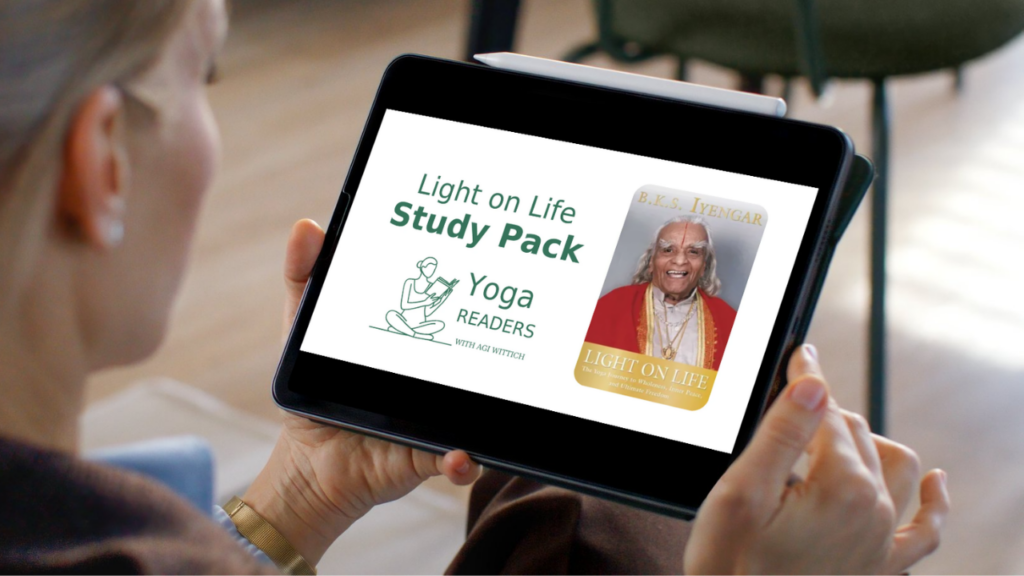
The Light on Life Study Pack is meant for dedicated students and teachers who want everything in one place.

This makes sense if you join late and want to catch up thoroughly, like to re-watch and take notes at your own pace, and want a compact resource you can revisit over months and years.

The Light on Life – Study Pack includes:

* All study session recordings (ongoing access)
* The Study Companion PDF — reading schedule, main themes, summaries, focus questions, reflection prompts, and Sanskrit terms for each gathering.
* Guiding and reflection questions, organised by session
* Sanskrit terms with transliteration and explanations

Buying the Study Pack is one way to support the time and research that go into Yoga Readers — and to receive a resource designed for long-term study.

Agi Wittich Avatar Photo

Agi Wittich PhD

Agi Wittich is a yoga practitioner since two decades, and is a certified Iyengar Yoga teacher. Wittich studied Sanskrit and Tamil at the Hebrew University of Jerusalem, Israel, completing a PhD with a focus on Hinduism, Yoga, and Gender. She has published academic papers exploring topics such as Iyengar yoga and women, the effects of Western media on the image of yoga, and an analysis of the Thirumanthiram yoga text.

Contact

Skip to content