
Light on Life: Chapter 2: Stability – The Physical Body
Sunday 7 February 2027 · 8:00 UTC, London (GMT, UTC+0) 8:00 AM, Israel (IST/IDT) 10:00 AM · free on Zoom Our reading of Light
Knowledge, Practice, and Healing
We have sent a 6-digit verification code to your email. Please enter it below to continue.
We have sent a 6-digit verification code to your email. Please enter it below to continue.
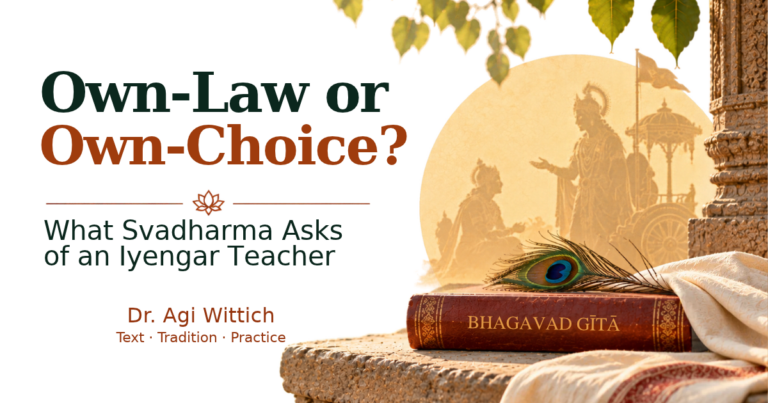
Most of us have stood at a decision that felt wrong while something deeper insisted that we make it. Arjuna meets this collision on the field of Kurukṣetra. His duty as a warrior asks him to fight his own teachers and cousins, and every family and ethical instinct he has tells him that the act is adharma, a violation of right order.
Kṛṣṇa answers him in Bhagavad Gītā 2.31–33, and his answer is direct:
“Further, considering your own-law, you should not waver. For there is nothing better for a warrior than a lawful war. Now, if you will not engage this lawful combat, then, by disregarding both own-law and honor, you will incur sin.”
(Bhagavad Gītā 2.31–33, Feuerstein, The Bhagavad-Gita, pp. 102–103)
A reader who comes to the Bhagavad Gītā for comfort may find this answer startling. Kṛṣṇa accepts the conflict as real, and tells Arjuna which law governs it. As an earlier essay in this series showed, such verses call for careful reading in their context.
The Sanskrit word is svadharma, “own-law,” which joins sva, “own,” with dharma. Georg Feuerstein explains it in a note:
“Like the concept of svabhāva (‘own-being’), its correlate svadharma (‘own-law’) is a vitally important notion in the ethics of the Mahābhārata. In brief, it is the normative behavior arising from one’s svabhāva. In Arjuna’s case, his birth into the warrior estate afforded him all sorts of privileges but also a good many obligations, notably the protection of the people and the preservation of the spiritually based law of his society.”
(Feuerstein, p. 103, n. 32)
Angelika Malinar draws the logic out:
“According to Kṛṣṇa, svadharma, the general social obligations of a warrior, clearly overrules kuladharma, Arjuna’s concern for the family. Not killing his relatives and refusing to fight constitute a sinful deed (pāpam, 2.33).”
(Malinar, The Bhagavadgītā: Doctrines and Contexts, pp. 104–105)
Kṛṣṇa also tells Arjuna that, seen metaphysically, his grief has no ground to stand on. Together these two arguments make the passage a reasoned reply to a crisis, far more than a command.
The text ties svadharma to birth and social class, varṇa: Arjuna’s own-law is a warrior’s law. A person born into a varṇa could know their role with relative ease. Today we have to find it for ourselves, and then follow it. I read modern svadharma as one’s calling, one’s heartfelt mission: the one thing a person is meant to do in this world. Feuerstein’s link between svadharma and svabhāva, “own-being,” supports this reading. When we know our calling, we also know the right direction.
A text speaks differently when we read it with its commentators, its language, and its living tradition.
B.K.S. Iyengar gives practitioners a way to hear this teaching. In his lecture “Yoga and Dharma,” which we met in the first essay of this series, he describes yoga as “the science of duty of the body, of the consciousness and of the self,” and dharma as that which “supports, sustains, upholds” those who fall. He then gives dharma a practical shape:
“Dharma also means the science of duty. Dharma is a code of conduct, a guide to live in the right direction.”
(Iyengar, Aṣṭadaḷa Yogamālā, vol. 1, p. 159)
In Light on Life, his river shows the same relationship. One bank is dharma, “the righteous duty that upholds, sustains, and supports our humanity” (p. 237). A life flows between the banks of duty and freedom, and the duties along that channel hold the water together.
I know this collision from my own path. A senior yoga teacher once told me that a practitioner needs devotion alone, free of questions and doubt. I have devotion and faith in me, and still the part of me that wants to inquire, again and again, kept asking. I am a scholar, and that belongs to my nature.
At the university, I heard the opposite. A serious scholar, I was told, keeps away from practicing yoga, because practice is “inauthentic” for a researcher and would make me seem biased and less objective to other scholars. I knew that these words and opinions could never take my practice from me. I needed it as much as I needed to ask questions, to inquire, and to research.
Each community saw half of my path as a mistake. For me, the two are inseparable. I am a scholar and a practitioner at the same time, and this is my own-law.
The collision Kṛṣṇa addresses appears whenever an action looks wrong from the outside while remaining the duty of the person who must perform it. A teacher who arrives at her class exhausted, grieving, or angry meets the same question. The question asks whether she can stand in the role that supports the people who came to learn, and it leaves aside whether she feels like teaching. Kṛṣṇa states the principle in chapter 3:
“Better is one’s own law, though imperfectly performed, than the law of another well performed. Better is death in one’s own law; the law of another is fraught with fear.”
(Bhagavad Gītā 3.35)
The verse asks for faithfulness to one’s own path, even when one walks it imperfectly. The Sanskrit word for “imperfect” here is viguṇa, lacking in quality.
My own-law has more than two strands. I am a scholar-practitioner, and I am also a mother-yogini. I will keep yoga alongside motherhood and my research, and I will keep motherhood alongside both. Some scholars and yoginis have chosen a path without motherhood; mine holds all three. So I follow my svadharma in a “good enough” way, in the words of the psychoanalyst D.W. Winnicott. The good-enough mother, for Winnicott, meets her child’s needs with real care and imperfect means, and that imperfection itself helps the child grow. Kṛṣṇa’s viguṇa, own-law imperfectly performed, says something similar. A life that holds several callings at once will meet each of them imperfectly, and each still remains one’s own.
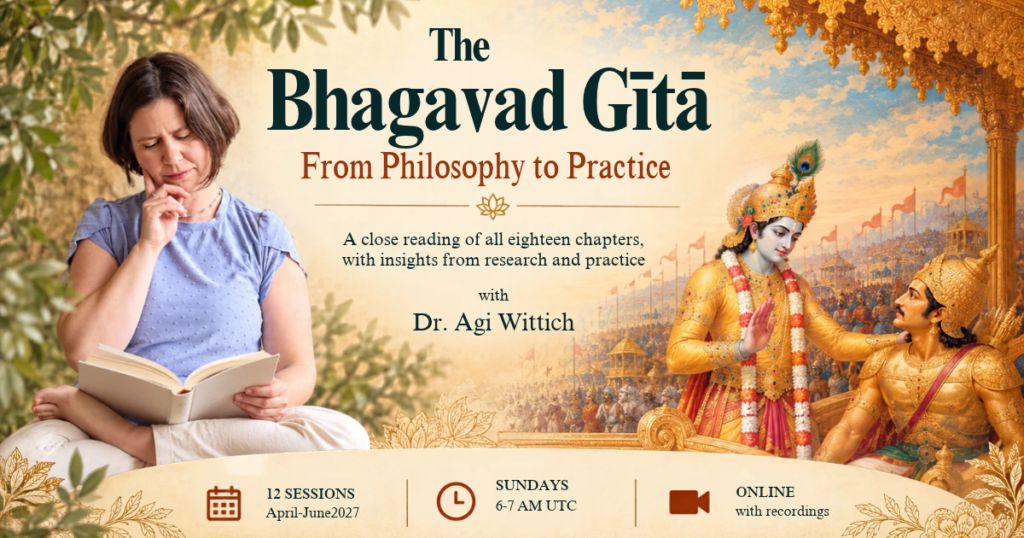
Twelve weeks, chapter by chapter, through the Sanskrit, B.K.S. Iyengar’s writings, and contemporary scholarship. Sundays on Zoom, from April 2027.
Early-bird NIS 1,190 (~$383) until 15 March 2027
[Reserve your place →]
Not ready yet? Receive the next essays by email →
Sunday 7 February 2027 · 8:00 UTC, London (GMT, UTC+0) 8:00 AM, Israel (IST/IDT) 10:00 AM · free on Zoom Our reading of Light
Sunday 24 January 2027 · 8:00 UTC, London (GMT, UTC+0) 8:00 AM, Israel (IST/IDT) 10:00 AM · free on Zoom Our reading of Light
Sunday 24 January 2027 · 8:00 UTC, London (GMT, UTC+0) 8:00 AM, Israel (IST/IDT) 10:00 AM · free on Zoom How to get the

Agi Wittich is a yoga practitioner since two decades, and is a certified Iyengar Yoga teacher. Wittich studied Sanskrit and Tamil at the Hebrew University of Jerusalem, Israel, completing a PhD with a focus on Hinduism, Yoga, and Gender. She has published academic papers exploring topics such as Iyengar yoga and women, the effects of Western media on the image of yoga, and an analysis of the Thirumanthiram yoga text.