
Light on Life: Closing Communal Session
Live Session: Sunday, December 13, 2026 | 08:00 UTC The Zoom link to this session is sent via our Newsletter, Whats’app & Facebook group
Knowledge, Practice, and Healing
We have sent a 6-digit verification code to your email. Please enter it below to continue.
We have sent a 6-digit verification code to your email. Please enter it below to continue.
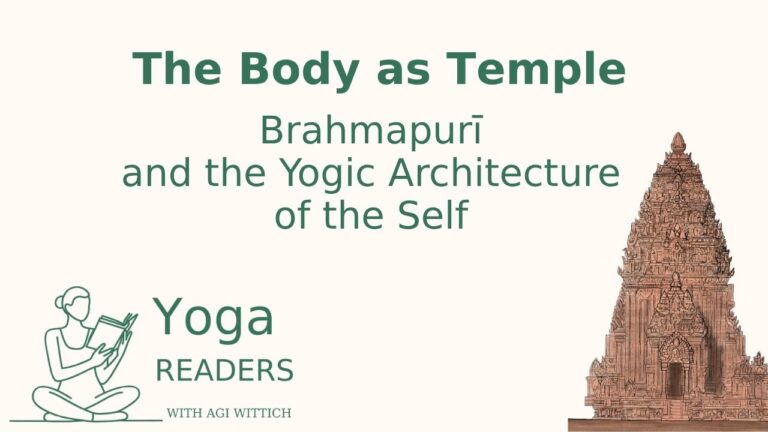
When we practice yoga, we often hear that “the body is a temple.” But what does this metaphor actually mean within the yogic tradition? And why does B.K.S. Iyengar return so often to the idea that the body is itself a sacred structure through which the Self may be realised?
In yogic thought, the human body is described as Brahmapurī [ब्रह्मपुरी], the “City of Brahman,” a sacred dwelling place of the Divine. To understand the body in this way is to shift from viewing it merely as a physical instrument to recognising it as a living temple in which consciousness itself resides. I explore this idea in several places in Iyengar’s work. In another article, for example, I discuss why Hanuman appears at the beginning of Light on Prāṇāyāma and what that reveals about the philosophical foundations of the practice.
This vision reflects a much older current within Indian philosophical traditions, where the body is repeatedly described as a sacred structure through which the deepest dimensions of reality may be realised. It also connects with the ancient yogic idea that yoga itself emerges from a cosmic source. I explore this more fully in my article on Hiraṇyagarbha, the primordial source of yoga.
The City of Brahman
The idea that the human body is a divine city appears already in the Upaniṣads, where the inner space of the heart is described as the dwelling place of ultimate reality. The Chāndogya Upaniṣad speaks of a “small lotus within the heart,” an inner chamber in which the entire universe is said to reside. Later philosophical traditions deepen this vision through a multilayered understanding of embodiment.
According to the Taittirīya Upaniṣad, the human being is composed of five interpenetrating sheaths, or kośas. These range from the most tangible layer, the annamaya kośa, the physical body sustained by food, to the innermost ānandamaya kośa, the sheath of bliss. Between them lie the physiological, psychological, and intellectual dimensions through which life, feeling, and cognition unfold.
Iyengar adopts this classical framework to describe the practitioner’s inward journey. The work of yoga gradually refines awareness through these layers, moving from the outer physical structure toward subtler dimensions of experience. The body is therefore not merely the starting point of practice. It is the very site through which interiority is cultivated.
The Nine Gates of the Body
Within this sacred architecture, the body is also described as a city with nine gates, nava-dvāra. This metaphor appears famously in the Bhagavad Gītā (5.13), where the embodied self is said to dwell within the “city of nine gates,” observing the activities of the senses without becoming entangled in them.
These nine gates correspond to the principal openings of the body through which perception and action connect us to the external world: the eyes, ears, nostrils, mouth, and the lower bodily openings. Through these gateways, the senses move outward, engaging constantly with the world. Meditative practice involves learning to quiet this outward movement. In yogic terms, this is pratyāhāra, the withdrawal of the senses. Symbolically, the gates of the city are drawn inward so that awareness may turn toward the indwelling Self.
The Subtle Infrastructure of the Temple
Inside this sacred city lies an intricate subtle anatomy described in yogic literature. Later haṭha yoga texts speak of a network of 72,000 nāḍīs, channels through which prāṇa, the vital life force, circulates throughout the body. Among these, three principal channels play a central role in yogic practice: iḍā, piṅgalā, and suṣumṇā. Along the axis of the spine lie the cakras, subtle centres that regulate the movement and transformation of energy within the body. Iyengar sometimes compares them to electrical transformers that regulate the “voltage” of prāṇa as it flows through the system.
These images need not be read as anatomical descriptions in the modern biomedical sense. They belong to a symbolic and experiential language developed within yogic traditions to guide practitioners in understanding the movements of breath, attention, and consciousness. Their purpose is not dissection, but orientation.
In practical terms, Iyengar insists on precision in the seated posture for prāṇāyāma. The spine must rise vertically so that the body forms a balanced central axis:
“If a vertical line is drawn from the centre of the head to the floor, the crown of the head, the bridge of the nose, the chin, the breastbone and the navel should be in alignment.”
(Light on Prāṇāyāma, p. 65)
This alignment is not cosmetic. It stabilises the nervous system and allows the breath to circulate evenly through the chest and lungs. Iyengar also compares the practitioner’s work to that of someone carefully arranging an interior space:
“Just as an interior decorator arranges a room to make it spacious, so does the sādhaka create maximum space in the torso to enable the lungs to expand fully in prāṇāyāma.”
(Light on Prāṇāyāma, p. 66)
Through this careful preparation, the body becomes a well-ordered sanctuary for breath.
The Body as Field: Kṣetra and Kṣetrajña
Iyengar repeatedly emphasises that the body must be cultivated as a field of awareness. Drawing on the Bhagavad Gītā’s distinction between kṣetra (the field) and kṣetrajña (the knower of the field), he explains that the body becomes the ground in which the experience of the Self may unfold:
“According to the Bhagavad Gītā the body is called the field (kṣetra) or abode of the Self (Ātmā), and the Self is the knower of the field (kṣetrajña), who watches what takes place when the body has been cultivated by prāṇāyāma.”
(Light on Prāṇāyāma, p. 66)
The body, with all its sensory, physiological, and psychological processes, is the field in which experience unfolds. This distinction between the field and the knower is simple in formulation, but in practice it requires sustained inquiry, especially when we begin to examine how attention moves between them in real time. I explore this more closely in the upcoming Threads in Patañjali’s Wisdom course.
The witnessing consciousness that observes these processes is the knower. Iyengar invokes this distinction to explain the deeper rationale behind the precision of yogic practice. The work of āsana is not simply physical training. It is a process of cultivating and clarifying the field so that the presence of the knower, the deeper Self, may become perceptible.
In this sense, the meticulous alignment characteristic of Iyengar Yoga serves a philosophical purpose. By refining the body, the practitioner gradually transforms it into a stable and receptive instrument for awareness.
Preparing the Temple for Breath
This understanding becomes especially important in the practice of prāṇāyāma. Sitting for breath regulation is not merely a matter of adopting a comfortable posture. It is the act of arranging the temple itself.
Iyengar stresses that posture must possess both firmness and intelligence:
“Keep the body firm as a mountain peak, and the mind still and steady as an ocean.”
(Light on Prāṇāyāma, p. 64)
This firmness is not rigidity, but stability. The body must be organised in such a way that it can support stillness without collapse. When that organisation is lost, clarity is disturbed:
“The moment the body loses its own intelligence or firmness, the intelligence of the brain loses its power of clarity.”
(Light on Prāṇāyāma, p. 64)
The posture therefore becomes the architectural foundation of the temple. When the seat is properly established, the body can support the quiet, spacious attention that prāṇāyāma requires.
Iyengar therefore insists on a steady, upright position in which the spine rises vertically like a mountain peak. The crown of the head, the bridge of the nose, the breastbone, and the navel are aligned along a central axis, while the shoulders and ears remain level. This geometric balance helps quiet the nervous system and creates the internal order necessary for subtler work.
At the same time, the application of Jālandhara Bandha, the chin lock, gently restrains the outward movement of the senses. When practised correctly, the brain becomes quiet, the heart remains cool, and the practitioner begins to sense a more inward state of stillness. What was initially a philosophical metaphor begins to take on experiential meaning.
Why the Temple Metaphor Matters for Prāṇāyāma
The metaphor of the body as a sacred temple becomes especially meaningful in prāṇāyāma because prāṇāyāma depends on conditions that are both physical and inward. Unlike āsana, where movement and muscular action are more visible, prāṇāyāma requires containment, interiority, and subtle attentiveness. The body must therefore function as a stable and well-ordered structure within which the breath can unfold without disturbance.
When the posture is balanced and the senses begin to quiet, the body is no longer experienced merely as matter to be manipulated. It becomes a vessel, a site of inhabitation. This is why Iyengar can state so succinctly:
“Prāṇāyāma is the bridge between the body and the Self.”
(Light on Prāṇāyāma, p. 66)
The significance of this statement is profound. Breath is not simply a physiological process to be managed. In prāṇāyāma, it becomes the medium through which the practitioner moves from gross embodiment toward subtler awareness. The body must be prepared carefully, not because the body is secondary, but because it is the very ground through which this transition becomes possible.
In this way, the metaphor of Brahmapurī, the City of Brahman, is not merely poetic or symbolic. It becomes practical. Each time the practitioner sits for prāṇāyāma, aligns the spine, steadies the body, quiets the senses, and allows the breath to move inwardly, the ancient metaphor becomes lived experience.
At that point, Brahmapurī is no longer simply an image to contemplate. It becomes a condition to inhabit. The practitioner is not merely thinking about the sacred city, but dwelling within it.
If you are already reading these ideas but find that they do not yet translate into experience, you are welcome to continue through my lectures, or to work with me directly in a more focused way.
Live Session: Sunday, December 13, 2026 | 08:00 UTC The Zoom link to this session is sent via our Newsletter, Whats’app & Facebook group
Live Session: Sunday, December 6, 2026 | 08:00 UTC Our reading of Light on Life begins with Chapters 6 & 7. The Zoom link
Live Session: Sunday, November 22, 2026 | 08:00 UTC Our reading of Light on Life cintinues with Chapters 4 & 5: Clarity & Wisdom
Agi Wittich is a yoga practitioner since two decades, and is a certified Iyengar Yoga teacher. Wittich studied Sanskrit and Tamil at the Hebrew University of Jerusalem, Israel, completing a PhD with a focus on Hinduism, Yoga, and Gender. She has published academic papers exploring topics such as Iyengar yoga and women, the effects of Western media on the image of yoga, and an analysis of the Thirumanthiram yoga text.