B.K.S. Iyengar describes his practice as meditative, and a reader can ask what that means for a teacher in front of a class. The answer in his own words rewards a close look. “There is meditation in everything. Indeed, in all these petals of yoga one needs a reflective or a meditative mood” (p. 15). He continues:
“Meditation is not a separate compartment. It is the quality of attention that can be brought to every action, whether it is āsana, prāṇāyāma, or the ordinary activities of the day.”
(Iyengar, Light on Life, p. 15)
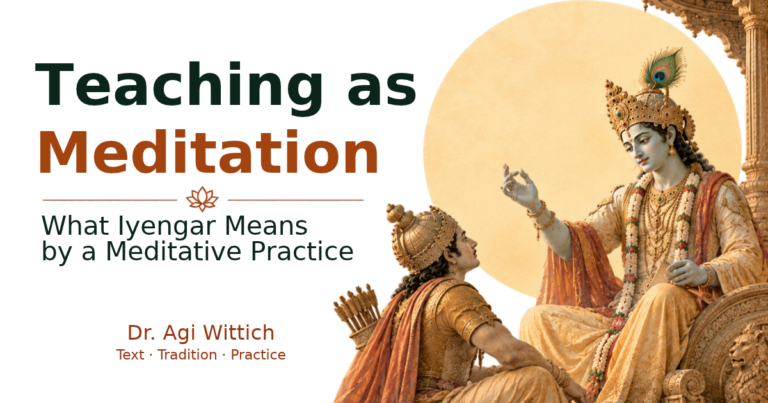
Later he repeats the point in technical language: “potentially there is dhyana in every aspect or petal of yoga” (p. 80). The word dhyāna, the seventh limb of Patañjali’s path, names sustained meditation. The Bhagavad Gītā gives this steadiness a lasting image: the mind of the yogi rests like a lamp in a windless place, whose flame stays still (6.19).
A mood inside the action
The claim describes the quality of attention inside the activity, and here, inside the class itself. A private sitting before class is a separate matter. When the teacher is connected, the sequence, the corrections, and the responses to students all come from steadiness, and the next outcome loosens its pull. The interaction itself becomes the meditation. This reading fits Kṛṣṇa’s portrait of the person of steady wisdom, who acts at full strength and stays level in success and failure (2.56–57). The teacher stays fully in the room and fully in the action, while the action leaves her mind free.
I know this state well from my own teaching. Often I “forget” myself: my worries, sometimes even a pain in my body, and I become fully absorbed in teaching. The next posture arrives without deliberation; the sequence seems to reveal itself. A sense of harmony spreads among the students as well. After such classes, students often tell me, “I felt you taught especially for me today,” and many of them say it after the same class. Afterward, I find it harder to remember what I taught, even though I trained myself to remember sequences and their logic. The Gītā describes this release of the sense of doership: actions unfold through the qualities of nature, and only the one deluded by ego thinks, “I am the doer” (3.27). In these classes, the teaching happens, and the “I” steps aside.
HOW WE’LL READ THE GĪTĀ
A text speaks differently when we read it with its commentators, its language, and its living tradition.
A fine distinction
Iyengar draws a careful line that every teacher can use. Describing āsana performed at the luminous, sāttvika level, he adds: “I do not say, ‘I am meditating.’ I am not. I am practicing asana but at a level where the quality is meditative” (pp. 181–182). He then explains where that quality comes from:
“The meditative quality arises when the effort becomes effortless and the mind is no longer grasping at the result.”
(Iyengar, Light on Life, p. 182)
Elsewhere he is blunt about teaching meditation as a subject: “meditation cannot be taught, it can only be experienced. Relaxation can be taught and is of immense value” (p. 217). The teacher creates the conditions, and the experience belongs to the student. The teacher also keeps her own claim light.
In my classes, I create these conditions through language. I choose words of awareness: observe, feel, check, notice. I give fewer instructions of doing, and more invitations to attend. The student keeps working in the posture, and the attention turns inward, toward the one who observes.
The test
The test is simple. A class planned around one goal, such as everyone reaching a full handstand, can stay meditative if the teacher holds the goal lightly. A class that begins open-ended can still feel agitated if the teacher searches for approval or a visible result. The difference lies in whether the teacher claims the outcome; the plan itself matters less.
Like Iyengar teachers worldwide, I plan my classes around a theme, a family of postures: standing poses, forward bends, backbends, inversions. Sometimes I arrive wanting to teach a certain pose, and the class needs something else, so I change the plan. At other times the class is ready for more, and I teach advanced postures I had not planned. The theme stays, and the class leads the way within it.
Kṛṣṇa offers an image for the teacher who passes this test: one who acts while offering the action and releasing attachment remains untouched, like a lotus leaf by water (5.10). The leaf rests on the water, and the water rolls off it.

Questions for reflection
- In your practice or teaching, when does the next outcome pull at your mind, and when does it let go?
- What conditions help a meditative quality arise in your practice?
- Which goal in your practice could you hold more lightly?
Sources
- Feuerstein, Georg. The Bhagavad-Gita: A New Translation. Shambhala Publications,
- Iyengar, B. K. S. Light on life. Rodale, 2005.
Read the whole Gītā with Dr Agi Wittich
Twelve weeks, chapter by chapter, through the Sanskrit, B.K.S. Iyengar’s writings, and contemporary scholarship. Sundays on Zoom, from April 2027.
Early-bird NIS 1,190 (~$383) until 15 March 2027
[Reserve your place →]
Not ready yet? Receive the next essays by email →