This essay belongs to our Yoga Readers reading of B.K.S. Iyengar’s Light on Life. We meet free on Zoom from Sunday, 17 January 2027. → Join the reading

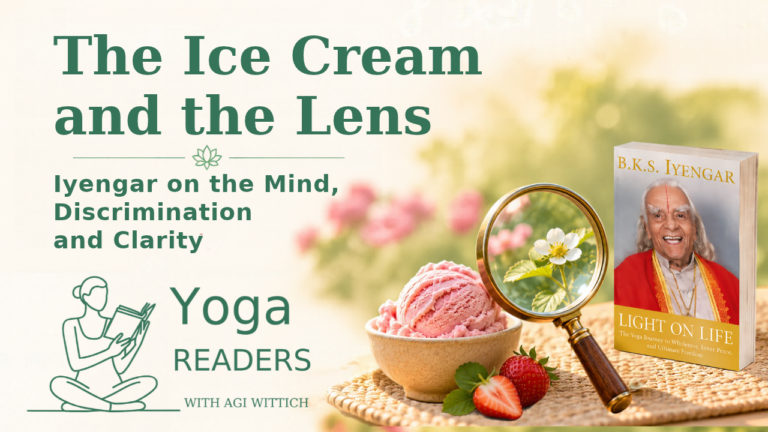
Chapter 4 gives us the restless mind and a tub of vanilla ice cream, and Chapter 5 gives us the lens of consciousness. The pairing of ancient psychology with a freezer door shows Iyengar at his most characteristic. This essay follows both chapters and asks one question about the pause between wanting and reaching.
Three parts of one consciousness
Iyengar organizes the inner world with a simple triad. “Yoga identifies three constituent parts to our consciousness (which it calls citta). They are mind (which is called manas), ego or self with a small ‘s’ (which is called ahamkara), and intelligence (which is called buddhi)” (p. 111). He describes each by its role. The mind sits on the outer layer: “Its nature is fickleness, unsteadiness, and inability to make productive choices. It cannot decide between good and bad, right or wrong, correct or incorrect.” Choosing belongs to intelligence, the inner layer. The innermost layer is ahaṃkāra. In his words, “Literally, ahamkara means ‘I-shape’” (p. 111).
The ice cream scene
Iyengar then illustrates how these three work together. You arrive home late and tired, you have already eaten, and you open the freezer. The eyes read the label and pass the information to the mind, the mind relays it to the ego, and the two “go into a huddle.” They consult memory: “Does the act of eating vanilla ice cream result in pleasure or pain?” Memory answers, “Pleasure,” and the ego says, “OK, give it to me” (pp. 128–129). A second telling adds the missing partner. Mind and ego sense “a sort of static buzz in the background of consciousness,” turn around, and “see intelligence jumping up and down” (p. 129). Intelligence asks a bigger question: “Do we live to eat, or eat to live?” (pp. 129–130). The ego protests, “It’s who I am,” and intelligence finally speaks: “For once I’m going to put my foot down (Will). I’m fed up with the rut you two are in, always the same, day in, day out” (p. 130).
The scene teaches how a habit forms and how it loosens. In the first telling, memory repeats a verdict from the past. In the second, intelligence adds the consequence, and the hand moves away from the door. The yogic word for the repeated impressions behind such moments is saṃskāra, and Iyengar describes the quick surface of consciousness as waves on a lake: “If consciousness is like a lake, there are primary waves or fluctuations of consciousness on the surface of the lake. These are easily discernible” (p. 131).
A TASTE OF YOGA READER'S LIGHT ON LIFE SESSION
These moments of clarity, what we call “aha” moments, come unexpectedly. Tradition teaches that deep meditation brings them about, but truly, they can arise at any time, in any place.
Discrimination as a knife edge
The next chapter names the faculty at work in the second telling. Viveka, discrimination, “is the knife edge of intellect, separating true from false, reality from unreality, using memory in such a way that past consequences are factored into our choices and decisions. If we can see consequences, we are not caught in the trap of apparent pain versus apparent pleasure” (p. 155). The ice cream story turns this definition into a household event. Discrimination works in an ordinary evening, in a kitchen, at a freezer door.
Cleaning the lens
Chapter 5 offers a second image, the lens of consciousness:
“Consciousness can be compared to a lens. Its inner surface faces the soul itself, and its outer surface comes into contact with the world. Inevitably a degree of grime attaches itself to that outer surface and obscures our vision. In fact it prevents us from seeing clearly what is outside, and it equally prevents the light of our soul from shining out. If our house is gloomy because the windows are dirty, we don’t say there is a problem with the sun; we clean the windows. Therefore yoga cleans the lens of consciousness in order to admit the sun (soul).” (p. 151)
The lens image removes blame. A gloomy house calls for clean windows, and the sun keeps shining. Iyengar also warns that polish can deceive: “We all know that an apple that appears perfect on the outside can have been eaten away by an invisible worm on the inside. Yoga is not about appearances. It is about finding and eradicating the worm, so that the whole apple, from skin inward, can be perfect and a healthy one” (p. 174).
From the freezer to freedom
The ice cream reappears near the end of the book, in the final chapter. Iyengar writes that mokṣa is “a thousand little freedoms that we accomplish each day,” and he gives two examples: “the ice cream returned to the freezer or the bitter retort left unsaid” (p. 239). Small acts of discrimination train the larger freedom. You find the pattern in the kitchen before you find it anywhere else.
Questions for reflection
- What happens in the three seconds before you reach for your own “ice cream”?
- Where do you notice the mind asking the ego for permission, and where does intelligence get a turn?
- Which window in your daily life needs cleaning this month?
If this essay spoke to you, join the Yoga Readers community. We read Light on Life chapter by chapter, and new essays reach subscribers before each session.
Join Yoga Readers
- The Zoom link and a reminder before every session
- The reading schedule and chapter summaries
- Focus questions and reflection prompts for each session
- The Yoga Readers Guide: how to read along and get the most from the journey
✅Is Yoga Readers free?
Yes. Everyone can take part in the live Yoga Readers reading, free of charge. You receive:
- Live Zoom gatherings, twice a month
- The reading schedule
- Short chapter summaries
- Session summaries: what we explored in each gathering
- Focus questions and reflection prompts on the website
- Our WhatsApp and Facebook groups
- Recordings of the Opening Gathering, the Closing Gathering, and the special conversation with a senior teacher
If you want to read, show up, and think together, you have everything you need.
Keep the whole cycle
Missed a session, or want to return to one? The Study Pack keeps every session recording and the Study Companion PDF with the themes, summaries, questions, and Sanskrit terms, so you can come back to the cycle for months and years.
Early-bird NIS 249 (~$78) until 20 December 2026