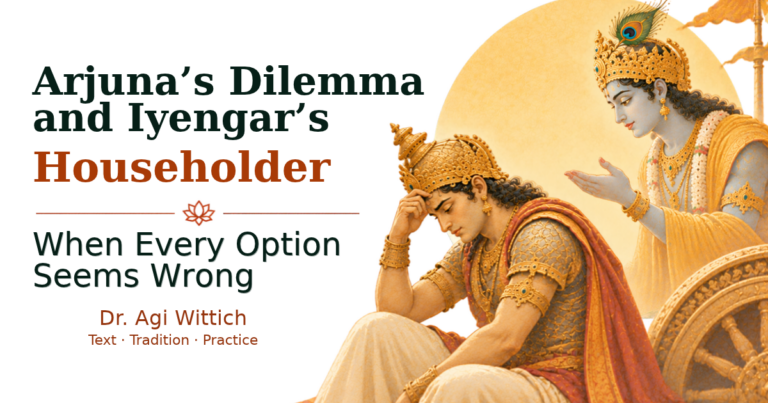
Most people who meet the Bhagavad Gītā remember Arjuna’s collapse at the start of its second chapter. He stands between two armies, sees relatives and teachers on the opposite side, and sees only wrong options. In Light on Life, B.K.S. Iyengar uses this moment to describe a difficulty that visits ordinary life as well. He has just told the story of his youth in Pune, with its poverty, ridicule, and relatives who would not let him into their kitchens, and then he widens the lens:
“Everyone sometimes finds themselves in the awful dilemma when every course of action or behavior seems to be wrong. Arjuna, in chapter 2 of the Bhagavad Gītā is on the horns of such a dilemma. To do nothing is an action too, with inevitable consequences, and so that is not a way to escape pain and suffering either. With Krishna’s help, Arjuna follows the path of dharma, of the science of religious duty, and so reconciles what is on the human and material level, irreconcilable.”
(Iyengar, Light on Life, pp. 53–54)
What is irreconcilable, reconciled
We have met the sentence “To do nothing is an action too” in earlier essays of this series. Here, its companion carries the weight: dharma “reconciles what is on the human and material level, irreconcilable.” Some dilemmas have no solution on their own level. Every option costs something, and staying still costs too. Iyengar’s point is that dharma opens another level. Kṛṣṇa’s answer gives Arjuna a ground to stand on, his own duty, svadharma, as a warrior, and teaches him to act from it while releasing the fruit of the action. The dilemma remains, and Arjuna finds a place from which to act within it.
I met such a dilemma during my last pregnancy. I had hyperemesis gravidarum, severe and persistent nausea, and teaching became very difficult. Every class was a struggle, and every class felt wrong. All I wanted was to stay home. Yet I felt the responsibility of teaching, and my students met me with great understanding. I kept teaching the whole time. Looking back, the dilemma never disappeared. What carried me through was the ground beneath it: my duty to the people who came to learn.
HOW WE’LL READ THE GĪTĀ
A text speaks differently when we read it with its commentators, its language, and its living tradition.
Iyengar’s own field of battle
Iyengar then turns to his own life. “In my own youth, it seemed impossible to be accepted by my students and by my family. But by persevering on the yogic path, I attained a level at which I am not only accepted but even now honored by my students and my family” (p. 54). The young Iyengar, poor, ridiculed, and unwelcome, stood in his own version of Arjuna’s position. His answer was perseverance on the path.
Perseverance has been the thread of my own teaching in recent years. Since COVID, keeping in-person classes alive has been hard. Many people turned to online classes, and studio practice became less popular. The rising cost of living made the classes harder to sustain financially. In times of war it grew harder still: people were afraid to leave their homes, and reluctant to commit to a year of practice when everything around them was uncertain. Through all of it, I kept teaching. My own teacher showed me this perseverance, and now I carry it on.
He sums up the lesson with a sentence that fits a householder’s week: “It is by facing up to adversity and suffering, and accepting it as a necessary means, that our anxieties are resolved and disappear. If we are loyal to the path we are on, our lives will get better, and the light of distant perfection will come to illuminate our journeys” (p. 54).
Facing adversity, at a human pace
The Bhagavad Gītā prepares this teaching early. Kṛṣṇa tells Arjuna that the contacts of the senses bring heat and cold, pleasure and pain; they come and go, and he asks Arjuna to endure them (2.14). Later, he defines yoga itself as the unyoking from union with suffering, a state in which one is not shaken even by great sorrow (6.22–23). Iyengar’s “facing up to adversity” and the Gītā’s endurance point the same way: suffering met with steadiness loses its power to rule us.
How much adversity a person can face, and when, is a personal line, and it shifts. We can face our difficulties when we are able to. Facing them while overwhelmed serves no one. For a teacher, this means honoring each student’s line, and trusting that steadiness grows in its own time. Endurance, in this sense, is a capacity that practice builds gradually, far more than a demand placed on the student.
The modern dilemma
The modern version of Arjuna’s dilemma rarely arrives as a single dramatic choice. It appears as the repeated sense that any response to a hard situation will cost something, in a relationship, in a reputation, or in one’s own peace. Iyengar’s reading invites a different question. Instead of searching for a cost-free option, we can ask what ground we are willing to stand on while we act. That ground, in the Bhagavad Gītā and in Light on Life, is dharma, and the practice of yoga is what makes it steady.

Questions for reflection
- When did every option before you seem wrong, and what ground did you stand on?
- Which adversity in your life became, in hindsight, a necessary means?
- Where is your own line today, between facing a difficulty and being overwhelmed by it?
Sources
- Feuerstein, Georg. The Bhagavad-Gita: A New Translation. Shambhala Publications, 2011.
- Iyengar, B. K. S. Light on life. Rodale, 2005.
Read the whole Gītā with Dr Agi Wittich
Twelve weeks, chapter by chapter, through the Sanskrit, B.K.S. Iyengar’s writings, and contemporary scholarship. Sundays on Zoom, from April 2027.
Early-bird NIS 1,190 (~$383) until 15 March 2027
[Reserve your place →]
Not ready yet? Receive the next essays by email →