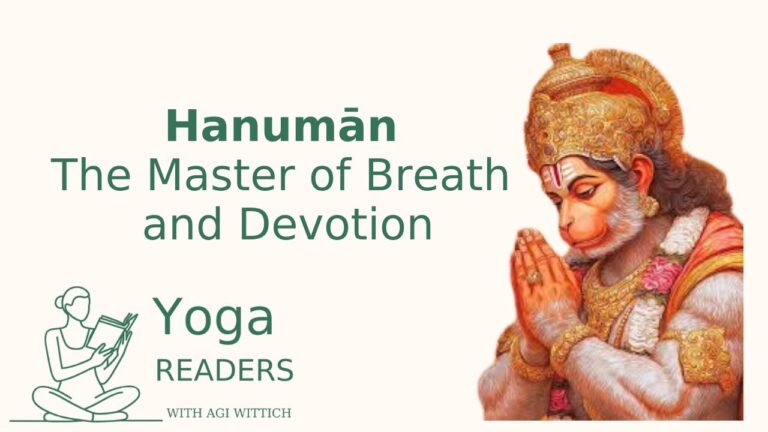
At the opening of Light on Prāṇāyāma, B.K.S. Iyengar invokes Hanumān [हनुमान्]. The reference is brief, almost passing, yet it is not incidental. Iyengar rarely places an image at the threshold of a text without pedagogical intent. The question, then, is not simply who Hanumān is within the sacred narrative, but why he appears precisely at the doorway of a book on prāṇāyāma.
This essay proposes that Hanumān functions as a psychological and yogic archetype for the inner conditions required in breath practice. Read in this way, he is not devotional ornament, nor mythological flourish, but a teaching device that reveals how Iyengar understands prāṇāyāma: as a discipline requiring courage, surrender, and the capacity to move between realms of experience.
For a related exploration of how cosmological imagery frames breath in Iyengar’s thought, see my article on Hiraṇyagarbha.
Hanumān and Breath
Hanumān’s connection to breath is not only symbolic but genealogical within the sacred narrative. He is traditionally called Vāyu-putra, the son of Vāyu, the wind deity. Vāyu in Vedic thought is not merely atmospheric wind but the personification of life-breath — the dynamic movement of prāṇa in the cosmos. Through this lineage, Hanumān becomes an embodiment of prāṇic vitality itself. His strength, agility, and tireless energy are expressions of unimpeded life-force. When Iyengar invokes Hanumān at the threshold of prāṇāyāma, he is not only referencing devotion and courage, but also pointing toward the intimate relationship between breath and the cosmic principle of Vāyu — the living movement that sustains both the universe and the practitioner.
Hanumān is traditionally associated with strength, vitality, and unwavering devotion. Yet in the context of prāṇāyāma, these attributes take on subtler meanings. Prāṇāyāma is not simply respiratory regulation; it is work with prāṇa — the life-force itself. Iyengar repeatedly emphasizes that breath bridges body, mind, and subtle awareness.
The refinement of breath therefore demands more than technique. It asks for steadiness of attention, humility before the unknown, and a willingness to encounter inner terrain that cannot be fully controlled — themes we also explore in our ongoing study cycles within the Yoga Readers community.
Hanumān, as the sacred narrative presents him, embodies precisely this combination: immense capacity paired with total devotion. His strength does not arise from ego but from surrender to a higher principle. In this sense, he mirrors the stance of the practitioner who approaches prāṇāyāma not as a performance but as an offering of attention.
Hanumān may also be read as a figure of the mind when it is aligned with prāṇa rather than driven by egoic impulse. In the sacred narrative, he does not act for personal gain; his intelligence serves a higher purpose. This mirrors a core principle of prāṇāyāma: the mind does not dominate the breath but learns to follow it, to listen, and to move in cooperation with a subtler intelligence. When attention becomes service rather than control, breath reveals its transformative capacity.
Courage and the Encounter with Abhiniveśa
Prāṇāyāma, especially in its subtler forms, can evoke vulnerability. Lengthened pauses, internal retention, and the quieting of habitual breath rhythms may bring practitioners into contact with unease — even with what classical yoga philosophy calls abhiniveśa, the deep-seated clinging to life and fear of dissolution.
Breath work touches the most basic movement of survival; to refine it requires trust. Hanumān’s courage in the sacred narrative is not reckless heroism but existential trust: a readiness to act without guarantee, sustained by devotion rather than self-assertion. The practitioner entering prāṇāyāma must cultivate a similar courage — not to conquer breath, but to remain present when control softens and awareness deepens.
For practitioners working with breath in a gradual, supported framework, I discuss this progression in more detail in a session recording on prāṇāyāma foundations.
The Leap Between Worlds
One of the most evocative moments in the sacred narrative is Hanumān’s leap from Bhārat to Laṅkā. In that crossing, he moves between worlds: from the familiar into the unknown, from one realm of existence into another. This movement offers a powerful analogy for breath itself.
Breath continuously travels between inner and outer worlds. With every inhalation and exhalation, it mediates between the organism and its environment, between personal interiority and shared atmosphere. In prāṇāyāma, this movement becomes conscious. The practitioner, like Hanumān, learns to cross thresholds — between effort and surrender, activity and stillness, the tangible and the subtle.
In the sacred narrative, Hanumān is also a dūta — a messenger between realms. Breath performs an analogous role within yoga practice. It carries information between body and mind, between conscious awareness and the subtle field of life. Just as Hanumān moves between worlds without belonging exclusively to either, breath mediates between inner and outer, personal and universal. Through prāṇāyāma, this mediating function becomes refined, and the practitioner begins to perceive breath as a carrier of awareness rather than merely air.
This “movement between worlds” is central to how I approach prāṇāyāma study in both textual and embodied forms, including our reading-and-practice cycles.
Devotion as Pedagogy
Hanumān’s defining quality is devotion. Within the Iyengar imagination, devotion is not sentimentalism but disciplined attention directed toward what is beyond the ego’s immediate preferences. To practice prāṇāyāma with devotion is to refine perception patiently, to respect the intelligence of the breath, and to accept gradual transformation.
This pedagogical stance characterizes Iyengar’s approach more broadly. Precision, discipline, and what he called “patient and careful effort” are not merely technical virtues but expressions of a philosophical orientation: first understand the known (the body), then approach the unknown with humility.
Devotion here implies not passivity, but the softening of the sense of personal doership. Advanced work with breath reveals that prāṇāyāma cannot be forced into submission; it unfolds when effort yields to receptive intelligence. Hanumān’s actions in the sacred narrative are powerful precisely because they are not self-claimed. Similarly, the practitioner gradually discovers that breath deepens not through assertion, but through a refined surrender that allows life-force to organize itself.
Why Hanumān at the Threshold of Prāṇāyāma?
If we read Hanumān through the lens of sacred narrative, psychological symbolism, and pedagogical intent, his placement at the opening of Light on Prāṇāyāma becomes clear. He represents the inner disposition required for breath work:
- courage to enter subtle terrain
- devotion that steadies the mind
- the ability to move between realms of experience
Hanumān thus becomes not an external deity but an inner compass. His leap mirrors the crossing enacted in each conscious breath. His courage steadies the practitioner before the vulnerability of inner silence. His devotion refines effort into offering.
In this way, Hanumān’s presence signals that prāṇāyāma is not merely technique, but a transformative encounter — one that unfolds where breath, awareness, and trust converge.