
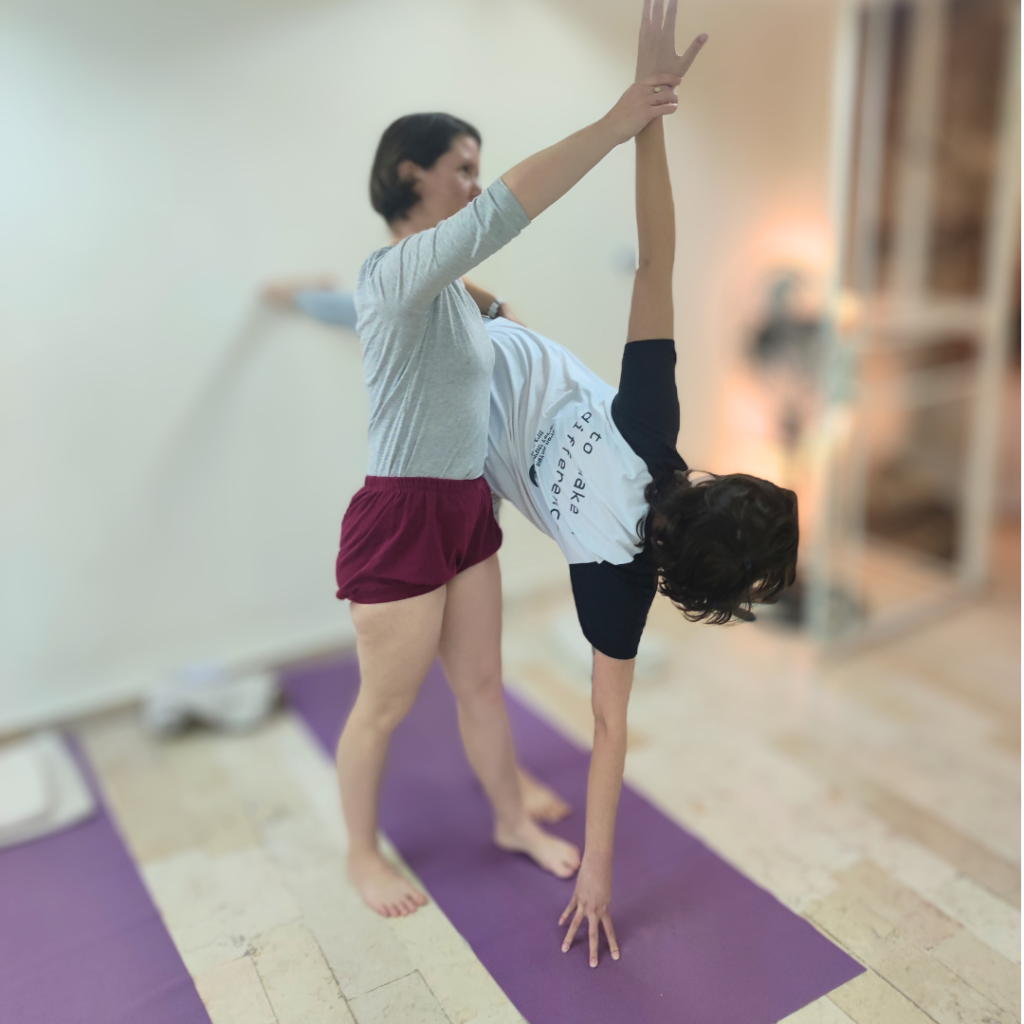
I teach Iyengar Yoga in Jerusalem מתוך commitment to the method as it evolved with B.K.S. Iyengar — a method that understands āsana as a disciplined inquiry.
Classes are not built around flow, music, or constant variation.
They are built around attention.
How an action is initiated.
How it stabilizes.
How structure supports breath.
How repetition refines understanding.
In this method, precision is not aesthetic ambition.
It is a form of discernment
The practice progresses gradually. Stability precedes intensity.
Props — blocks, belts, blankets, chairs — are used as tools of clarification.
They do not make the work easier; they make it more intelligible.
Remaining in a posture is not about endurance.
It is about refinement.
We study relationships between the feet and the ground; between the pelvis and the spine; between breath and structure; since the depth emerges through continuity, not novelty.
As the Yoga Sūtras state (I.14):
“Practice becomes firmly grounded when cultivated over a long time, without interruption, and with dedication.”
This is less a quotation and more a principle of organization.
How to Begin?
Send me a short WhatsApp message. A few words about your background (if any), relevant physical conditions, and what you are looking for at this stage. I will recommend the appropriate class, and we schedule a trial session.
I am Dr. Agi Wittich — a scholar and teacher. Academic research and embodied practice are not separate domains for me. Both involve interpretation: of text, of structure, of experience.
In the studio, as in textual study, we question assumptions.
We refine perception through action.
In addition to being a certified Iyengar Yoga teacher, I am a scholar of yoga in Religious Studies and a recognized yoga therapist. I work with NATAL (Israel Trauma and Resiliency Center) and with PTSD rehabilitation projects of the Ministry of Defense. This experience informs how I teach: with clarity, pacing, and respect for thresholds.
The classes are not therapy sessions.
They are, however, structured with an understanding of regulation and resilience.
Location, Schedule & Pricing
Classes are small and consistent. There is continuity across the year. This is a framework for sustained practice. Students join because they are looking for depth, not variety.
Mishkenot Sha’ananim — one of the quieter areas of central Jerusalem. Within walking distance of Yemin Moshe and The First Station.
In this quiet and historic neighborhood, Iyengar Yoga is taught in small, intimate groups, integrating physical precision, inward observation, and a deepening understanding of body, mind, and the yogic path. The classes are open to students of all levels — from complete beginners to experienced practitioners and yoga teachers — and are adapted to the individual needs of each participant.
Parking is available nearby (Liberty Bell Park area), and the location is accessible from central neighborhoods. The studio is simple and fully equipped for precise work.
Who Are These Classes For?
Iyengar Yoga is suitable for everyone. You do not need to be flexible, strong, or “in shape” in order to begin. The method meets you exactly where you are. Through precise, gradual, and responsible practice, real change unfolds over time.
Practice progressively improves flexibility in muscles and ligaments, strengthens bones and muscular structure, develops stability, concentration, and steadiness of will, and cultivates clarity in breath, mood, and awareness.
What Happens in Class?
In these classes, postures are adapted to the practitioner, not the other way around.
Props such as blocks, blankets, belts, and chairs are used to support precision, understanding, and accessibility in practice. Each class includes clear verbal guidance, demonstrations when needed, and hands-on adjustments, always with sensitivity to individual comfort and consent. Learning is gradual and cumulative. Each class builds upon previous work. For this reason, attending at least one class per week consistently is key to progress and depth.
What Characterizes Iyengar Yoga?
The Iyengar method is known for technical precision, deep attentiveness, and intelligent sequencing grounded in principles of safety, individual adaptation, and structural understanding.
It is a method that supports rehabilitation, physical refinement, and inner development alike. There are no shortcuts in yoga – instead, there is a path. It begins with one class, taken seriously, and sustained with continuity.
Sunday 17:00-18:30
Tuesay 18:00-19:30
Tuesday 19:45-21:15 (women only)
Wedsnday 9:00-10:30
All classes take place at Malkhi 10 street in Mishkenot Sha’ananim
Classes operate in accordance with the regulations and safety guidelines of the Ministry of Health and the Home Front Command.
Upon entering the practice space, please maintain quiet. You are welcome to arrive up to 10 minutes before the beginning of class. Late entry is discouraged.
When you register for a regular class, your place in the group is reserved for you. If you do not cancel your attendance at least 3 hours before class, the session will be counted as attended.
Cancellation of a membership requires prior notice of at least one month. Cancellations cannot be applied retroactively.
Classes do not take place on Israeli holidays and national observances (including holiday eves and memorial days). If a class is cancelled for any other reason, notice will be given as early as possible.
Please inform me of any relevant medical conditions so that the practice can be adapted appropriately, and to determine whether medical clearance is required for participation.
Women who are menstruating or pregnant should avoid certain postures. Please consult with me before the class begins.
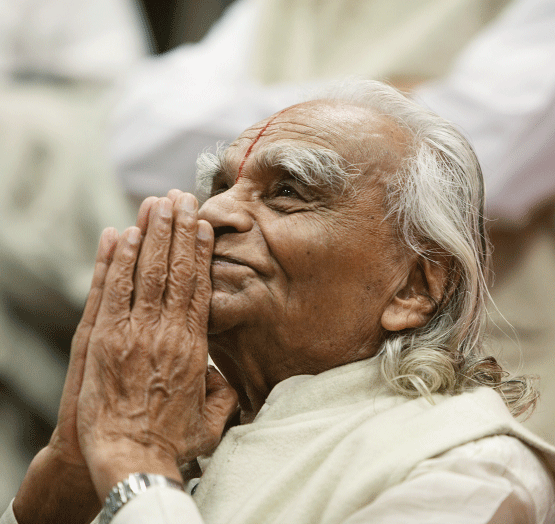
Iyengar Yoga is a tradition of practice founded by B.K.S. Iyengar, who taught internationally between 1936 and 2014 and established the first Iyengar Yoga institute in Pune, India.
B.K.S. Iyengar (Bellur Krishnamachar Sundararaja Iyengar) was born in 1918 in the village of Belur, in the state of Karnataka, South India. At the age of fifteen, he began studying yoga under his brother-in-law and teacher, the yogi T. Krishnamacharya, in Mysore. Three years later, he was sent to teach in Pune, where he continued to develop and refine his method.
In the 1970s, Iyengar began teaching in the West, and in 1975 he established the Ramamani Iyengar Memorial Yoga Institute in Pune, named in memory of his late wife, Ramamani.
His daughter Geeta Iyengar, his son Prashant Iyengar, and his granddaughter Abhijata Iyengar continue to teach and transmit the method.
B.K.S. Iyengar passed away on August 20, 2014.
Iyengar Yoga is characterized by emphasis on correct posture and structural alignment in every āsana; Precision in execution, often supported by the use of props; Sustained duration in postures; Adaptation of postures to the individual capacity of the practitioner; Consistency and continuity of practice; and the development of awareness, observation, and concentration.
At its core, the method seeks to cultivate clarity — through disciplined attention to structure, breath, and action.
Yes. You do not need to arrive prepared.
Iyengar Yoga is not based on natural flexibility or prior athletic ability. It is based on learning how to act with precision. Strength and mobility develop through consistent, structured practice.
We begin from where you are.
In most cases, yes.
Please write to me in advance with relevant details. The method allows for thoughtful adaptation through props, sequencing, and pacing.
The goal is not to push through pain, nor to avoid movement altogether, but to work intelligently and progressively.
In more complex medical situations, appropriate professional clearance may be required.
Not at all.
Beginning within a structured framework can be an advantage. It allows you to build a clear foundation from the outset, rather than unlearning habits later.
Yes, provided there is space in the group and the level is appropriate.
Since the classes are continuous and progressive, I recommend a short consultation before joining to ensure the fit is right.
You may begin with a trial class.
However, this is not a drop-in model. The work is cumulative. Understanding develops through repetition and continuity.
If you are looking for occasional attendance without regular commitment, this structure may not be the best fit at this time.
You may complete it in another class during the same week, subject to availability and prior coordination.
Regular attendance is strongly encouraged, as continuity supports depth.
Comfortable clothing that allows for movement and precision.
All props are provided in the studio.
There is no requirement to commit for an entire year.
You are welcome to begin with a trial class and then choose a rhythm that is sustainable.
At the same time, this method is rooted in continuity. Even once or twice weekly, practiced consistently, allows the work to take root.