Knowledge, Practice, and Healing

lol yr october 2026 (15)

No Retirement for the Yogi: Iyengar on Samādhi, Kaivalya and Lifelong Practice

This essay belongs to our Yoga Readers reading of B.K.S. Iyengar’s Light on Life. We meet free on Zoom from Sunday, 17 January 2027. → Join the reading

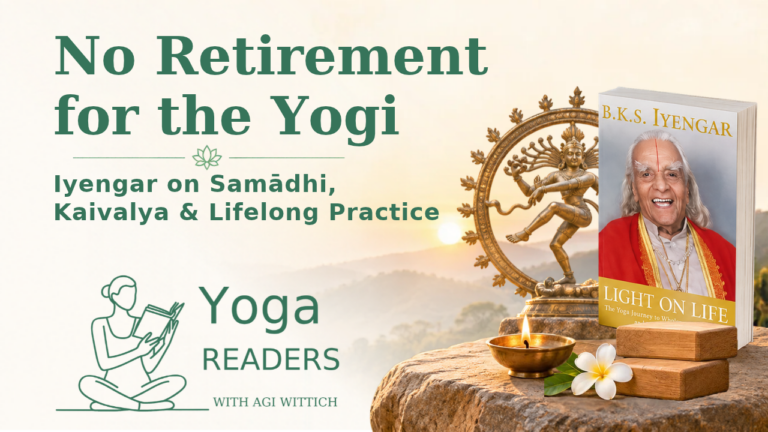
Iyengar gives us a tennis star as an image for lifelong practice. A young champion plays for the crowd, and later in life the same player returns with something deeper. Iyengar describes his own version: after an accident in 1979 that “robbed me of my prowess,” he writes, “I had to learn wisdom, wisdom through adversity. What came back was maturity, an intelligence that informed action” (p. 221). Then he completes the comparison:

“He remains faithful to the game and to its traditions and continued well-being. This is bhakti, service and devotion. For the yogi there is no retirement. But, as for the tennis player, there is a change of state, a role both more humble and more exalted. Maybe the tennis player will one day stop. The yogi cannot. Within the physical limits imposed by age, with a lifelong discipline behind him, and with growing love and compassion, he must continue.” (p. 222)

Samādhi is an experience, and kaivalya is a way of living

Chapter 6 reaches toward ānanda, bliss, and ends by drawing the distinction between two high points of the path:

“Samadhi is only a state where you experience the absorption of the body, mind, and soul as a single unit. But from samadhi, we have to reach a higher and subtler state called kaivalya (eternal emancipation or freedom in action). I said that in samadhi you are but cannot do.” (p. 224)

The word samādhi comes from sam (“together”), ā (“toward”) and dhā (“to place”). It names the state in which the mind rests fully on its object until knower, knowing and known merge. Kaivalya comes from kevala, “alone,” and it names the freedom that Patañjali sets as the goal of his fourth chapter. Iyengar compresses the difference with a joke: “Samadhi is a state of being in which you cannot do. You cannot catch a bus when in samadhi. In a state of oneness, how would you be able to discriminate which one to get on? Samadhi leaves the practitioner changed forever, but he still has to get dressed in the morning, eat breakfast, and answer his correspondence” (p. 228). Action asks for discrimination, and absorption suspends it. The path continues beyond absorption because life continues.

A TASTE OF YOGA READER'S LIGHT ON LIFE SESSION

These moments of clarity, what we call “aha” moments, come unexpectedly. Tradition teaches that deep meditation brings them about, but truly, they can arise at any time, in any place.

Action without color

How does a free person act? Iyengar answers with the language of color. “Actions are either black, which means they are entirely rooted in selfish motivations and lead to painful consequences, or white, disinterested and good or, like most actions, grey, in that they stem from mixed motives and therefore bring mixed results” (p. 137). The highest kind of action stands free of color. He ties it to the present moment: “direct perception, the ability to see reality in the present, as it is, without prejudice, and act accordingly. This is what it truly means to live in the present moment. If we perceive and act in the present, then we are coming closer to the yogic ideal of what is called an action without taint or without color” (p. 137).

When I try to name what this looks like in my own work, I think of teaching or practising from a calm and clean place, free of desires, fixed convictions, a goal to achieve, or a judgment to make. In that place the class unfolds and I stay with it, and I leave the result with the students.

The people who keep working

Iyengar’s line “For the yogi there is no retirement” has faces for me. My herbalist teacher, my academic mentor and my own teacher all keep working, and each plans to continue. For them, teaching belongs to life itself, and the words career or job fall short. Their example makes the sentence concrete: a vocation lasts as long as the person does. I recognize the same pull in myself. My life goal stays with me for life.

Iyengar describes the freedom behind this continuity in his account of the free person: “A yogi’s actions may each be very small, but if each is perfect in its time and place, their cumulative effect is considerable” (p. 231). He lists five qualities of such a life: “courage, vitality, right and useful memory, awareness through living in the present moment, and total absorption in his activities” (p. 229).

A thousand small freedoms

The book’s own phrase for the daily version is mokṣa, freedom, in small installments: “a thousand little freedoms that we accomplish each day” (p. 239). Kaivalya remains “majestic and permanent,” he says, “but we must not belittle the small daily victories of moksa” (p. 239). Lifelong practice consists of those small victories, repeated on ordinary days.

Questions for reflection

  1. Which teacher or colleague shows you what “no retirement” looks like?
  2. What does action “without color” look like in the part of your life that least resembles a yoga class?
  3. What would you notice about a class if you taught it from a calm and clean place?

If this essay spoke to you, join the Yoga Readers community. We read Light on Life chapter by chapter, and new essays reach subscribers before each session. 

Join Yoga Readers

Name(Required)
Email(Required)
Privacy(Required)
✅Is Yoga Readers free?

Yes. Everyone can take part in the live Yoga Readers reading, free of charge. You receive:

  • Live Zoom gatherings, twice a month
  • The reading schedule
  • Short chapter summaries
  • Session summaries: what we explored in each gathering
  • Focus questions and reflection prompts on the website
  • Our WhatsApp and Facebook groups
  • Recordings of the Opening Gathering, the Closing Gathering, and the special conversation with a senior teacher

If you want to read, show up, and think together, you have everything you need.

lol yr october 2026 (11)

Keep the whole cycle

Missed a session, or want to return to one? The Study Pack keeps every session recording and the Study Companion PDF with the themes, summaries, questions, and Sanskrit terms, so you can come back to the cycle for months and years.

Early-bird NIS 249 (~$78) until 20 December 2026

Continue Reading

Agi Wittich Avatar Photo

Agi Wittich PhD

Agi Wittich is a yoga practitioner since two decades, and is a certified Iyengar Yoga teacher. Wittich studied Sanskrit and Tamil at the Hebrew University of Jerusalem, Israel, completing a PhD with a focus on Hinduism, Yoga, and Gender. She has published academic papers exploring topics such as Iyengar yoga and women, the effects of Western media on the image of yoga, and an analysis of the Thirumanthiram yoga text.

Contact

Skip to content