Knowledge, Practice, and Healing

14. present mindedness in Āsana

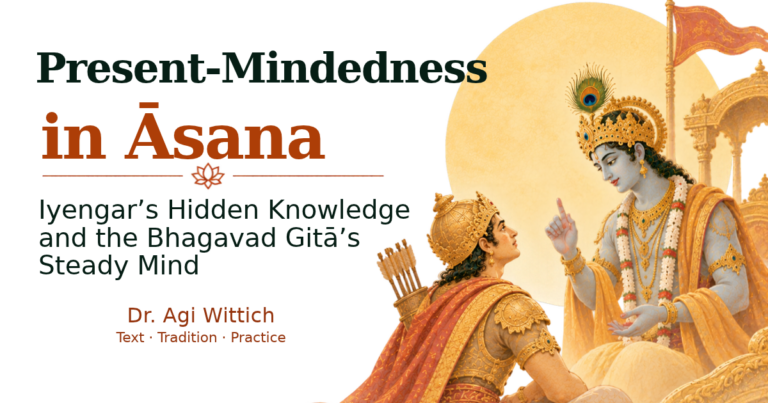
Present-Mindedness in Āsana: Iyengar’s Hidden Knowledge and the Bhagavad Gītā’s Steady Mind

A student can misread pratyāhāra as dissociation, as though the practitioner leaves the body or the situation. The Bhagavad Gītā describes the reverse. In chapter 6, Kṛṣṇa compares the restrained mind to a lamp:

“As a lamp in a windless place does not flicker, so the yogī of controlled mind remains steady in his meditation on the Self.”
(Bhagavad Gītā 6.19)

The image shows steadiness, and the flame stays exactly where it is. Feuerstein’s note on the verse makes the same point:

“The senses are not abolished; they simply cease to dictate the movements of the mind. The practitioner remains fully present while the objects of the senses lose their power to compel.”
(Feuerstein, The Bhagavad-Gita, p. 127, note on 6.19)

The practitioner is fully present, and the objects of the senses stop dictating the next movement.

For me, the difference lies in presence. Dissociation is absence: the person has left. Pratyāhāra is presence within: still listening, still aware. From the outside, the two can look alike, and even an experienced teacher finds it hard to tell them apart. That is one more reason to teach pratyāhāra as a movement into the body, so that students learn to recognize it from the inside.

Iyengar on the hidden knowledge

In the previous essay, we met Iyengar’s teaching that “in each āsana there is a hidden knowledge,” and that “absent-mindedness is night, whereas present-mindedness is day” (Aṣṭadaḷa Yogamālā, vol. 3, p. 42). In the same passage, he says who misses that knowledge:

“The others who do not know the value of āsana at all call it body culture. They do not know the positioning of the body properly and pride themselves as self-realized persons. Not that they are ignorant, but they are absent-minded. So you have to take away the absent-mindedness from your practice.”
(Iyengar, Aṣṭadaḷa Yogamālā, vol. 3, p. 42)

For Iyengar, the opposite of hidden knowledge is absence more than ignorance. Present-mindedness opens the door, and he names the effort it takes: “One needs to do tapas for this” (p. 42).

HOW WE’LL READ THE GĪTĀ

A text speaks differently when we read it with its commentators, its language, and its living tradition.

Tapas: the heat of attention

The Sanskrit word tapas comes from the root tap, “to burn” or “to heat.” In Light on Life, Iyengar describes it as “intense, purifying heat, a fire that, like the alchemist’s, transforms base metal into gold” (p. 157). He continues:

“Tapas is the fire of practice that burns away the impurities of body and mind. Without this heat the hidden knowledge of the āsana remains inaccessible.”
(Iyengar, Light on Life, p. 157)

Inside a single posture, tapas takes a modest form: the repeated return of attention to the present moment of the pose.

In my own practice, the tapas of forward bends was patience. For a long time I put great effort into them, and they hurt. Slowly I learned to release the excess effort and the suffering, and simply to let go, to be present, to surrender. Now forward bends open a vast inner space whenever I practice them. Seated postures, my absolute favorites today, bored me at first: a few minutes of sitting still, changing legs, and sitting again. With time, I came to treasure them for the stillness they gave me. And as I have described in an earlier essay, Śīrṣāsana revealed itself only when I stopped pouring so much effort into it. In each case, the hidden knowledge waited for a quieter fire.

Two ways to do a pose

Light on Life gives this idea a precise anatomy. Iyengar contrasts a posture done “mechanically from the front brain,” where “the action is felt only on the peripheral body, and there is no inner sensation, there is no luminous inner light,” with a posture done “with continual reference to the back of the brain,” where “there is a reaction to each action, and there is sensitivity” (p. 39). The second kind of practice resembles the Gītā’s lamp. The attention stays in the body, and goes further into it.

In class, I teach this distinction through the gaze. When we focus on a point, we can feel ourselves looking from the front of the brain, from the face. When we let the gaze go soft and unfocused, as when we gaze into space, we feel ourselves looking from the back of the head. The eyes stay open, and the seeing moves inward.

Iyengar describes the result in vivid terms: “We are developing such an intense sensitivity that each pore of the skin acts as an inner eye” (p. 29). As we saw in an earlier essay, he pictures this state as a wild deer in the forest, its senses turned inward “with equal acuity” (p. 152). The deer’s senses stay fully awake, and only their direction changes.

An observable difference

A teacher can see the difference in a room. When attention is absent, the practitioner adjusts the pose according to habit, or according to what the eye expects to see. When attention is present, the same shape reveals new information. The body stays in the pose, and becomes better known.

Questions for reflection

  1. In which posture do you practice from the front brain, and in which from the back?
  2. Which posture bored you at first, and what did patience reveal in it?
  3. When you soften your gaze, where do you feel yourself seeing from?

Sources

  • Feuerstein, Georg. The Bhagavad-Gita: A New Translation. Shambhala Publications, 2011.
  • Iyengar, B. K. S. Light on life. Rodale, 2005.
  • Iyengar, B. K. S. Aṣṭadaḷa Yogamālā, Vol. 1. New Delhi: Allied Publishers, 2007.

Read the whole Gītā with Dr Agi Wittich

Twelve weeks, chapter by chapter, through the Sanskrit, B.K.S. Iyengar’s writings, and contemporary scholarship. Sundays on Zoom, from April 2027.
Early-bird NIS 1,190 (~$383) until 15 March 2027
[Reserve your place →]
Not ready yet? Receive the next essays by email →

Continue Reading

Agi Wittich Avatar Photo

Agi Wittich PhD

Agi Wittich is a yoga practitioner since two decades, and is a certified Iyengar Yoga teacher. Wittich studied Sanskrit and Tamil at the Hebrew University of Jerusalem, Israel, completing a PhD with a focus on Hinduism, Yoga, and Gender. She has published academic papers exploring topics such as Iyengar yoga and women, the effects of Western media on the image of yoga, and an analysis of the Thirumanthiram yoga text.

Contact

Skip to content