Knowledge, Practice, and Healing

16. the warrior who sits still

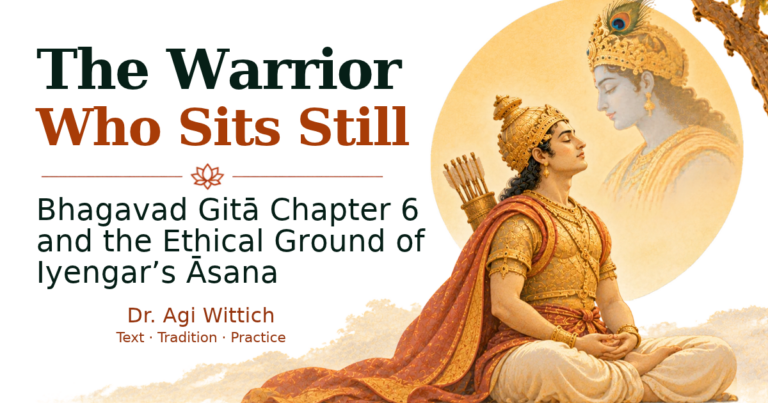
The Warrior Who Sits Still: Bhagavad Gītā Chapter 6 and the Ethical Ground of Iyengar’s Āsana

Chapter 6 of the Bhagavad Gītā describes a practice that Arjuna performs while he remains a warrior. His bow stays in the story, and his duty stays with him. Kṛṣṇa asks for a steady mind before the next action. As we saw in an earlier essay, the practice begins with a firm seat in a clean place (6.10–12). Then Kṛṣṇa describes the sitting itself:

“Holding the body, head and neck erect and still, gazing at the tip of the nose without looking around, serene, fearless, firm in the vow of celibacy, with mind controlled, let him sit, intent on Me.”
(Bhagavad Gītā 6.13–14)

This is the fullest account of seated practice in the Bhagavad Gītā. It differs from the eight-limbed path of the Yoga Sūtras, and it gives the minimum condition under which a person can act with intelligence intact. The posture is steady, and the gaze rests at the tip of the nose, nāsikāgra. The sitting has a direction: “intent on Me,” mat-para, oriented toward something larger than the self.

Two words in the verse ask for a closer look. The first is “fearless,” vigata-bhīḥ. For me, fearlessness in yoga is the courage to face ourselves. Much happens within us, and the practice asks us to meet it. Sitting still, with nowhere to go, we meet whatever arises, and fearlessness lets us stay.

The second is the vow of brahmacarya, usually translated as celibacy. B.K.S. Iyengar, himself a householder, reads brahmacarya as moderation and as faithfulness within marriage, and this is how I teach it. The vow becomes a discipline of energy, available to those who live family lives as fully as to renunciates.

The ethical ground beneath the seat

For Iyengar, the seat draws its meaning from ethics. As an earlier essay explored, he warns that even the highest practitioner who abandons the ethical base will fall, and he calls ethical perfection the only true proof of a practice’s accomplishment. Yama and niyama, the restraints and observances that open Patañjali’s path, stand beneath the posture as its condition. Brahmacarya is one of them. Their presence turns the seat into a means of knowledge, and keeps it connected to the life around it.


HOW WE’LL READ THE GĪTĀ

A text speaks differently when we read it with its commentators, its language, and its living tradition.

The practitioner stays in the field

Present-mindedness expresses that ethical ground in practice. The practitioner remains in the kṣetra, the field of circumstances, and the field stops commanding the mind. Iyengar himself chose the world over the saffron robe, and practiced inside it. The seated practice of the Bhagavad Gītā and the life of action belong to a single person, and Kṛṣṇa’s instruction in 2.48 joins them: “established in yoga, perform actions.”

Steadied or merely distracted?

Here lies a question every practitioner, and every teacher, meets sooner or later. A mind that practice has steadied differs from a mind that has drifted away from its duty. The first returns to its role with more clarity. The second avoids the role for a while. From outside, both can look like the same quiet sitting.

Sometimes we long to escape life, and we try to use the practice for that, too. Yet the practice keeps bringing us back: to ourselves, to the truth, to the present. Yoga leads home, every time. I once had a student who left the practice for exactly this reason. She had come to yoga to escape the “noise” of everyday life, and after two years of practicing with me, she was angry that I had never “let her” escape, and had always “made her” face life. It frustrated her. I felt sorry for her, and I also understood: the practice had done what it does.

The Gītā offers a simple test: the evidence appears afterward, in the quality of the next action. Arjuna sits so that he can stand and act. A practice that steadies returns us to life a little clearer, a little kinder, a little more able to meet what waits. The seat of 6.11–14 serves exactly this return.

Questions for reflection

  1. After your practice, how do you return to your duties?
  2. When have you wished to escape through practice, and where did the practice lead you instead?
  3. What in yourself does your practice ask you to face with courage?

Sources

  • Feuerstein, Georg. The Bhagavad-Gita: A New Translation. Shambhala Publications, 2011.
  • Iyengar, B. K. S. Light on life. Rodale, 2005.
  • Iyengar, B. K. S. Aṣṭadaḷa Yogamālā, Vol. 1. New Delhi: Allied Publishers, 2007.

Read the whole Gītā with Dr Agi Wittich

Twelve weeks, chapter by chapter, through the Sanskrit, B.K.S. Iyengar’s writings, and contemporary scholarship. Sundays on Zoom, from April 2027.
Early-bird NIS 1,190 (~$383) until 15 March 2027
[Reserve your place →]
Not ready yet? Receive the next essays by email →

Continue Reading

Agi Wittich Avatar Photo

Agi Wittich PhD

Agi Wittich is a yoga practitioner since two decades, and is a certified Iyengar Yoga teacher. Wittich studied Sanskrit and Tamil at the Hebrew University of Jerusalem, Israel, completing a PhD with a focus on Hinduism, Yoga, and Gender. She has published academic papers exploring topics such as Iyengar yoga and women, the effects of Western media on the image of yoga, and an analysis of the Thirumanthiram yoga text.

Contact

Skip to content