
Light on Life: Chapter 2: Stability – The Physical Body
Sunday 7 February 2027 · 8:00 UTC, London (GMT, UTC+0) 8:00 AM, Israel (IST/IDT) 10:00 AM · free on Zoom Our reading of Light
Knowledge, Practice, and Healing
We have sent a 6-digit verification code to your email. Please enter it below to continue.
We have sent a 6-digit verification code to your email. Please enter it below to continue.
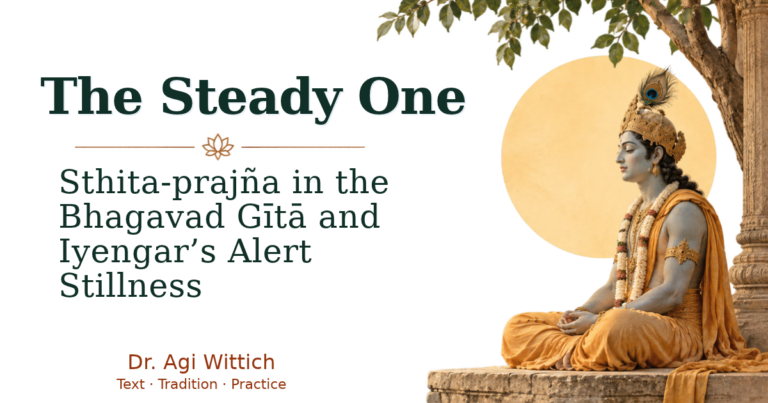
The first essay in this series ended with Arjuna collapsed on his chariot seat, and with a first glimpse of steady wisdom. Once Kṛṣṇa begins to answer, Arjuna asks a further question (2.54). He wants to know how the person of steady wisdom speaks, how such a person sits, and how such a person moves. The Sanskrit term is sthitaprajña: sthita means “standing, steady,” and prajñā means “wisdom, insight.” Together they describe one whose wisdom stands firm. Arjuna’s question is practical. He asks what steadiness looks like in a living person, and Kṛṣṇa’s answer fills the rest of the chapter (2.55–72).
The steady one meets sorrow with a settled mind and meets pleasure free of craving; attachment, fear, and anger have loosened their hold (2.56). He stays level in good and bad outcomes (2.57). He draws in his senses as a tortoise draws in its limbs (2.58), and he lives free from the sense of “I” and “mine” (2.71). Kṛṣṇa completes the tortoise image in two verses:
“When he withdraws his senses from the sense-objects, as a tortoise [withdraws] its limbs from all sides, then his insight is firmly established. The objects of the senses turn away from the abstinent dweller in the body, but the taste for them remains. Even this taste turns away when the Supreme is seen.”
(Bhagavad Gītā 2.58–59, Feuerstein, The Bhagavad-Gita, p. 113)
The second verse adds a crucial nuance. Turning away from the objects leaves their taste, rasa, alive. The taste itself falls away only when the Supreme is seen. In this reading, steadiness grows from a change in seeing, more than from the effort of restraint.
A text speaks differently when we read it with its commentators, its language, and its living tradition.
The portrait describes a person who acts at full strength while the mind stays settled. As we saw in the first essay, Kṛṣṇa insists that every being acts at every moment (3.5), and the steadiness Arjuna asks about remains available inside action. Kṛṣṇa points to King Janaka and others, who reached perfection through action itself (3.20). A person can know this steadiness and still lead a household, a class, or a country.
The thread continues into chapter 14, where Kṛṣṇa describes the one who has gone beyond the guṇas, the three qualities of nature:
“He who is the same in honour and dishonour, the same to friend and foe, abandoning all undertakings, he is said to have transcended the guṇas.”
(Bhagavad Gītā 14.25)
At first, “abandoning all undertakings” seems to call for withdrawal. Read alongside chapter 3, the phrase points elsewhere. The “qualities born of nature” that move every being to act (3.5) are these same guṇas. The one who stands beyond them still acts, and lets go of undertakings driven by desire for their fruits. The evenness of 14.25 extends the evenness of 2.57: the steady one of chapter 2 and the one beyond the guṇas of chapter 14 share one face.
The tortoise travels far beyond the Gītā. Patañjali names the withdrawal of the senses pratyāhāra, the fifth limb of yoga (Yoga Sūtra 2.54), and yoga teachers often illustrate it with the Gītā’s tortoise. A tortoise draws in its limbs and keeps them. In this image, withdrawal protects the senses for their return: the tortoise stretches out again and walks on. Malinar makes the same point:
“The withdrawal of the senses is not an end in itself but the precondition for the mind to become steady… The tortoise image indicates a temporary and controlled retraction that leaves the senses intact.”
(Malinar, The Bhagavadgītā: Doctrines and Contexts, p. 113)
In my classes, pratyāhāra sometimes arrives on its own. As concentration deepens and the mind grows still, a student may miss an instruction, or a question another practitioner raises nearby. Patañjali describes this movement in the same sūtra: as the senses disengage from their objects, they follow the nature of the mind itself (2.54). At other times, pratyāhāra comes through letting go in Śavāsana and restorative practice, or through deep attention to the breath in prāṇāyāma. Each time, it feels like coming home, to a quiet and welcoming home. What remains is fullness: the fullness of being present within.
Iyengar on alert stillness
Light on Life gives the steady mind a vivid picture. In the chapter on wisdom, B.K.S. Iyengar writes that consciousness “must become passively alert,” and he says what that looks like: “not placid like a cow contentedly chewing the cud, but alert and receptive like a wild deer in the forest, except that whereas the deer’s senses are turned outward, the yogi’s, with equal acuity, are directed inward” (p. 152). The cow is quiet, and the deer is steady. Both are still, and only the deer is fully awake.
In class, I teach this alert stillness as witnessing. Witnessing sits between two pulls: the drift toward numbness and sleep, and the urge to move or to act. I ask students to stay awake to the first and still before the second, aware and free of judgment, and simply to witness.
Iyengar brings this alertness into daily life. The yogi, he writes, “continues to function and act in the world, but in a way that is free” (p. 228), and he says the same in plainer words:
“Yoga is not about escaping from life. It is about living more fully, with greater awareness and greater freedom.”
(Iyengar, Light on Life, p. 229)For Iyengar, this freedom rests on ethical ground:
“The practice of āsana, without the ethical background of yama and niyama, is merely physical… Yama and niyama are like the foundation on which the six-storied building of yoga is raised.”
(Iyengar, Aṣṭadaḷa Yogamālā, vol. 2, p. 203)
The qualities in Kṛṣṇa’s portrait, freedom from attachment, fear, and anger, read like the fruit of this foundation. Steadiness in the Gītā and steadiness on the mat grow from the same ground.
Steadiness, again and again
I lose steadiness often, because life keeps moving and everything fluctuates. I regain my ground through continuous willpower, through discipline, and through a deep sense of yoga as the true path. Kṛṣṇa himself admits that the mind is restless and hard to hold, and he answers that practice (abhyāsa) and non-attachment (vairāgya) hold it (6.35). For me, the sthitaprajña names a state we reach again and again, perhaps daily. Each time we reach it, we know that we stand on the right path.
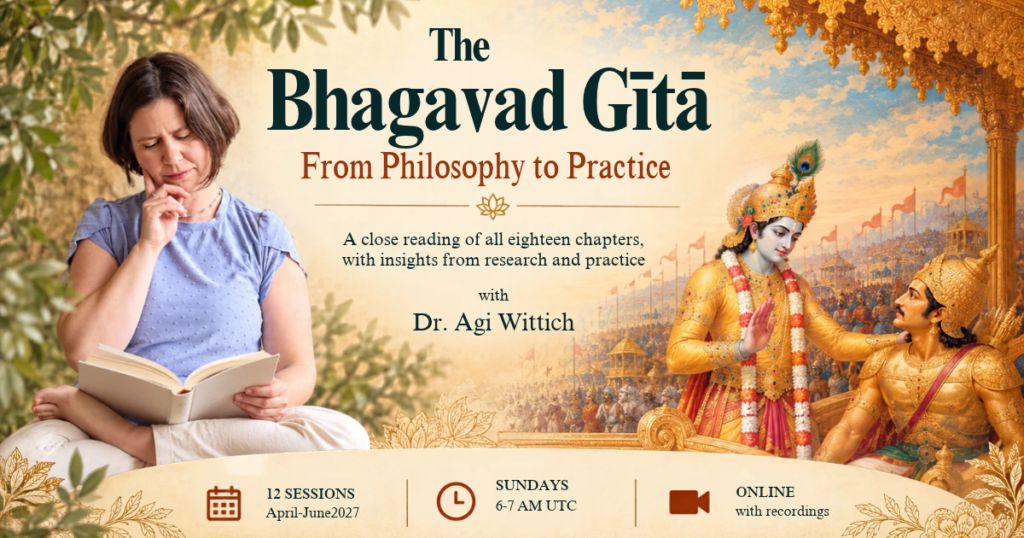
Twelve weeks, chapter by chapter, through the Sanskrit, B.K.S. Iyengar’s writings, and contemporary scholarship. Sundays on Zoom, from April 2027.
Early-bird NIS 1,190 (~$383) until 15 March 2027
[Reserve your place →]
Not ready yet? Receive the next essays by email →
Sunday 7 February 2027 · 8:00 UTC, London (GMT, UTC+0) 8:00 AM, Israel (IST/IDT) 10:00 AM · free on Zoom Our reading of Light
Sunday 24 January 2027 · 8:00 UTC, London (GMT, UTC+0) 8:00 AM, Israel (IST/IDT) 10:00 AM · free on Zoom Our reading of Light
Sunday 24 January 2027 · 8:00 UTC, London (GMT, UTC+0) 8:00 AM, Israel (IST/IDT) 10:00 AM · free on Zoom How to get the

Agi Wittich is a yoga practitioner since two decades, and is a certified Iyengar Yoga teacher. Wittich studied Sanskrit and Tamil at the Hebrew University of Jerusalem, Israel, completing a PhD with a focus on Hinduism, Yoga, and Gender. She has published academic papers exploring topics such as Iyengar yoga and women, the effects of Western media on the image of yoga, and an analysis of the Thirumanthiram yoga text.