Knowledge, Practice, and Healing

13. the tortoise and the returning mind

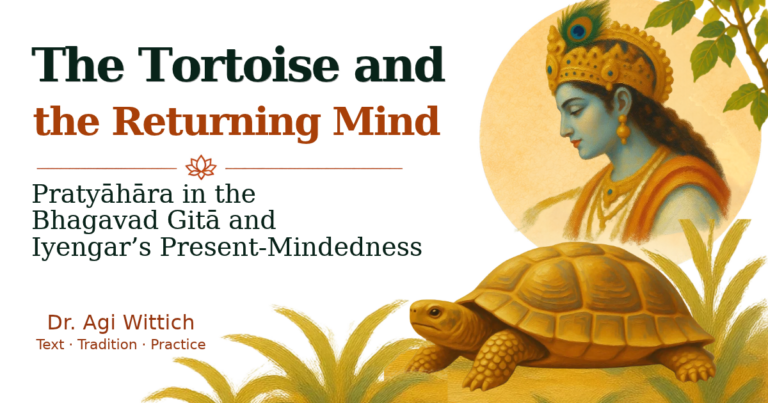
The Tortoise and the Returning Mind: Pratyāhāra in the Bhagavad Gītā and Iyengar’s Present-Mindedness

The Bhagavad Gītā describes a mind that is restless, turbulent, and hard to restrain. In chapter 6, Arjuna puts the problem to Kṛṣṇa and compares the mind to the wind. How can a person whose mind wanders practice yoga at all? Kṛṣṇa answers with a method:

“The mind is restless, turbulent, strong and unyielding, O Kṛṣṇa. I consider it as difficult to control as the wind.”
“Without doubt, O mighty-armed one, the mind is difficult to restrain and restless; but by practice and by dispassion it is restrained.”
(Bhagavad Gītā 6.34–35)

Kṛṣṇa accepts the difficulty in full, and answers with practice, abhyāsa, and dispassion, vairāgya. In several places, he returns to a single image for how the practice feels.

The tortoise

As we saw in an earlier essay, the image comes in 2.58: the person whose insight stands firm withdraws the senses from their objects, as a tortoise withdraws its limbs from all sides (Feuerstein, The Bhagavad-Gita, p. 113). The Sanskrit name for this withdrawal is pratyāhāra, from prati, “back, toward,” ā, “in,” and the root hṛ, “to draw.” Patañjali names it as the fifth limb of the eight-limbed path (Yoga Sūtra 2.54).

The image describes a temporary and purposeful act. The senses stay intact, and the practitioner holds them back so that the mind can steady itself. In chapter 6, Kṛṣṇa describes the setting for this practice:

“Let the yogī constantly discipline himself, remaining in a solitary place, alone, with mind and self controlled, free from expectations and from any possessions. Having established a firm seat for himself in a clean place, neither too high nor too low… let him sit, making the mind one-pointed, with the workings of the mind and the senses restrained, and practice yoga for the purification of the self.”
(Bhagavad Gītā 6.10–12)

The verses go on to describe an erect body, a steady gaze, and a mind directed inward (6.13–14). The practice engages body and mind together, and it prepares the practitioner to act later with steadiness.

Kṛṣṇa’s description pictures a solitary renunciate. For the householder, who, like Iyengar, has chosen the world, the clean place and the firm seat take a different form. Ever since I first rented a home of my own, I have kept a dedicated yoga room. That is where I practice. It is my sanctuary, my clean place inside a householder’s life.


HOW WE’LL READ THE GĪTĀ

A text speaks differently when we read it with its commentators, its language, and its living tradition.

Present-mindedness and absent-mindedness

B.K.S. Iyengar names the same movement in the vocabulary of the studio. In Aṣṭadaḷa Yogamālā, he contrasts present-mindedness with absent-mindedness:

“In each āsana there is a hidden knowledge which one does not explore at all. One needs to do tapas for this. Absent-mindedness is night, whereas present-mindedness is day.”
(Iyengar, Aṣṭadaḷa Yogamālā, vol. 3, p. 42)

The practitioner must move from the first to the second to enjoy āsana. “You will enjoy āsana when you have developed this present mindedness” (p. 42).

In the studio, this difference shows itself in the body. An absent mind can lead to injury, to imbalance, and to a posture that is less alive. When the mind wanders, certain muscles disengage, and the eye can see it. When a student practices with concentration, the muscle tone changes, and so do the breath and even the color of the skin. One sign stands out for me: in a demanding posture practiced with full awareness, the face and the breath show less effort. The posture works hard, and the practitioner stays at ease. Present-mindedness is day, and in daylight, the whole body can be seen.

The night-and-day contrast has a close companion in the Bhagavad Gītā. In 2.69, Kṛṣṇa says that what is night for all beings is the time when the self-restrained person is awake. Iyengar draws his image without citing this verse, and the two fit together well. The tortoise, in this reading, draws its limbs in so that it can remain where it is, awake, while stimuli pull at it from every side.

The Contribution of Light on Life 

Iyengar describes pratyāhāra in Light on Life as a turn of the current: “Pratyahara is the stage at which we learn to reverse the current that flows from mind to senses, so that mind can bend its energies inward” (p. 176). He shows how the breath prepares this turn: “It is impossible, when we turn our attention to the inner movement of breath, to use our senses externally at the same time. You cannot also be thinking that you must stop at the supermarket on the way home after work” (p. 73). Prāṇāyāma, in his words, “is the hinge between extroversion and introversion” (p. 73).

As a teacher, I meet this hinge from the outside. The inward turn happens within the student, beyond what I can see. I teach, I instruct, and I trust that each student will arrive when ready. What I can see are the signs of the outward pull: hands or legs that move, eyes that wander, a tilting head, an uneven breath, sometimes a soft snore. Each sign shows where the current still flows outward, and where the next instruction can meet it.

Questions for reflection

  1. When is your mind most like the wind, and what steadies it?
  2. In which posture do you find the “hidden knowledge” Iyengar speaks of?
  3. Where is the clean place and firm seat of your own practice?

Sources

  • Malinar, Angelika. The Bhagavadgītā: Doctrines and Contexts. Cambridge University Press, 2007.
  • Feuerstein, Georg. The Bhagavad-Gita: A New Translation. Shambhala Publications, 2011.
  • Iyengar, B. K. S. Light on life. Rodale, 2005.
  • Iyengar, B. K. S. Aṣṭadaḷa Yogamālā, Vol. 3. New Delhi: Allied Publishers, 2007.

Read the whole Gītā with Dr Agi Wittich

Twelve weeks, chapter by chapter, through the Sanskrit, B.K.S. Iyengar’s writings, and contemporary scholarship. Sundays on Zoom, from April 2027.
Early-bird NIS 1,190 (~$383) until 15 March 2027
[Reserve your place →]
Not ready yet? Receive the next essays by email →

Continue Reading

Agi Wittich Avatar Photo

Agi Wittich PhD

Agi Wittich is a yoga practitioner since two decades, and is a certified Iyengar Yoga teacher. Wittich studied Sanskrit and Tamil at the Hebrew University of Jerusalem, Israel, completing a PhD with a focus on Hinduism, Yoga, and Gender. She has published academic papers exploring topics such as Iyengar yoga and women, the effects of Western media on the image of yoga, and an analysis of the Thirumanthiram yoga text.

Contact

Skip to content