
Light on Life: Chapter 3: Vitality – The Energy Body (Breath)
Sunday 21 February 2027 · 8:00 UTC, London (GMT, UTC+0) 8:00 AM, Israel (IST/IDT) 10:00 AM · free on Zoom Our reading of Light
Knowledge, Practice, and Healing
We have sent a 6-digit verification code to your email. Please enter it below to continue.
We have sent a 6-digit verification code to your email. Please enter it below to continue.
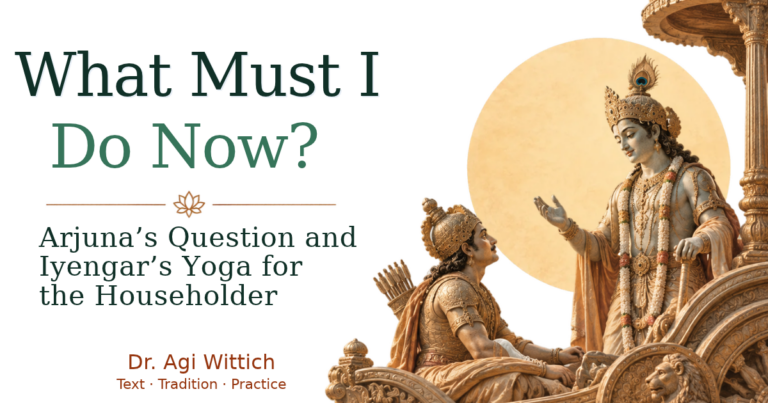
The Bhagavad Gītā opens with action. The Yoga Sūtras open with a definition: yogaś citta-vṛtti-nirodhaḥ, “yoga is the stilling of the movements of the mind” (1.2). The Gītā opens on a battlefield. Arjuna has already asked Kṛṣṇa to place his chariot between the two armies (1.21). He sees his teachers, cousins, and friends in the opposing ranks, and the question that opens the dialogue concerns action. He asks what he must do now, and leaves the nature of the Self for later. The first chapter closes with Arjuna setting down his bow and sinking onto the chariot seat (1.47).
The collapse arrives first in the body. Arjuna describes it himself:
“My limbs sink down, and my mouth dries up, a tremor comes upon my body, and my hair stands on end. Gāṇḍīva [the bow] slips from my hand, and my skin too is burning. I am not able to stand still, and my mind seems to whirl.”
(Bhagavad Gītā 1.28–30, Feuerstein, The Bhagavad-Gita, p. 90)
Before Arjuna can name his confusion, his body names it for him: the sinking limbs, the dry mouth, the burning skin, the hand that lets the bow slip. I have seen this order many times in my own classes. Working with students who live with anxiety disorders or PTSD, I often recognize the bodily signs of a rising wave before the student feels it as anxiety. It can happen in prāṇāyāma, in restorative practice, or in any posture, most often in backbends, and sometimes already in Tāḍāsana, the first pose of the class, right after we chant Oṁ together. When I see these signs, I adapt the instruction to meet the wave as it rises. At the end of class, students often tell me that they felt seen, that they received a tool for meeting the anxiety as it builds, and that the wave calmed during the practice. The Gītā begins its teaching at exactly this point, where body and mind come apart together, and it begins with a teacher who sees.
From there, Arjuna turns to Kṛṣṇa. The second chapter opens with his request for teaching: confused about his duty, he places himself before Kṛṣṇa as a student, śiṣyas te ‘ham, “I am your disciple” (2.7). The dialogue becomes a teaching relationship at the moment of greatest need.
A text speaks differently when we read it with its commentators, its language, and its living tradition.
I like to read the Gītā alongside the Yoga Sūtras. Most yoga practitioners know both texts, and comparison teaches us about each of them. I also read the Gītā with two kinds of guides. Scholars give us the tools to read a Sanskrit text closely: its terminology, its philology, its historical and cultural setting. B.K.S. Iyengar gives us the insight of a serious yogi who dedicated his life to this subject and generously shared his experience and understanding. His metaphors often bring these ancient texts within reach of our own lives. In this series, I keep both voices in the room.
The opening sets the Bhagavad Gītā apart from the Yoga Sūtras. Patañjali defines yoga and then maps the mind, its afflictions, and the practices that bring it to stillness. The Gītā places a person inside a collision of duties and asks how action remains possible. Each starting point asks something different of the reader. The Sūtras invite us to understand the mind as the ground of practice. The Gītā asks us to act well while still confused, and to let understanding grow through action and dialogue.
The text is a dialogue, and a dialogue moves. The same teaching returns in later chapters, and each time Arjuna’s emotional and cognitive state has shifted, so Kṛṣṇa gives the answer again in a new register.
The setting already holds the philosophical problem. The very first verse calls the battlefield dharma-kṣetre kuru-kṣetre, “on the field of dharma, on the field of the Kurus.” Dharma names the right order of things and one’s duty within it; Kuru names the family line; kṣetra means “field.” The conversation takes place on the field of action itself, and Arjuna stays there to receive his instruction, standing where the action must happen.
Angelika Malinar reads the place name as a statement of what is at stake:
“The battlefield is the place where dharma is to be protected and restored… The very name Kurukṣetra already indicates that the battle is about the maintenance of the socio-cosmic order.”
(Malinar, The Bhagavadgītā: Doctrines and Contexts, p. 55)
In this reading, the field is public and shared: the order of family, society, and cosmos depends on what happens there.
The word returns in chapter 13, where Kṛṣṇa turns the field inward:
“This body, O son of Kuntī, is called the field. He who knows it is called the knower of the field by those who know.”
(Bhagavad Gītā 13.1–2)
Read together, the two passages open a second meaning alongside the first. The battlefield of the opening verse and the field of body and mind that the practitioner comes to know belong to one teaching. The Gītā keeps both in view: the outer field, where duties collide, and the inner field, where the knower learns to see.
B.K.S. Iyengar reads the Gītā’s situation as the situation of an ordinary practitioner, the householder (gṛhastha). In Light on Life he asks, “is not the greater challenge and greater fulfillment to be found living in the world with its tribulations and temptations, and at the same time to maintain both balance and self-control in the everyday life of a householder?” (p. 21). He brings Arjuna in by name when he writes of a dilemma in which every course seems wrong: “To do nothing is an action too, with inevitable consequences” (p. 53).
Here Iyengar echoes Kṛṣṇa’s teaching in the third chapter:
“No one can remain even for a moment without performing action. Everyone is made to act helplessly by the qualities born of nature.”
(Bhagavad Gītā 3.5)
Kṛṣṇa also exposes a withdrawal that only looks like renunciation:
“He who restrains the organs of action but sits remembering the objects of the senses is called a hypocrite.”
(Bhagavad Gītā 3.6)
Stepping back from the field still leaves the mind on the field, among its objects and its worries. The question shifts from whether to act to how to act.
Today we call this collision work-life balance, and it remains unclear where yoga belongs in it. Is practice a duty that sustains us, like work? Or does it belong to the “life” side of the equation, as the support of our living? My students meet this question every day. Should they practice in the morning before work, or in the evening after the children fall asleep? They search for the time, and for a way to hold a serious practice inside full lives. The Gītā speaks directly to them. It brings yoga out of the forest and into the household, into the battles of daily life, onto the field itself.
Iyengar gives this duty a wider frame. He describes yoga itself as a science of duty, and dharma as a sustaining force:
“Yoga is one of the foremost and most refined forms of Indian art based on an extremely subtle science, the science of duty of the body, of the consciousness and of the self… Dharma is that which supports, sustains, upholds those who have fallen physically, morally or spiritually, or those who are falling, or those who are about to fall.”
(Iyengar, Aṣṭadaḷa Yogamālā, vol. 1, pp. 157–158)
In this light, Arjuna’s collapse and the householder’s daily struggle meet. Dharma upholds the one who is falling, and practice becomes a way of standing again: in the body, in consciousness, and in the self. The householder and the warrior share a field.
The second chapter moves from Arjuna’s collapse toward its opposite, the sthitaprajña, the person of steady wisdom. Kṛṣṇa describes this person:
“He who is unattached to everything, and when he experiences anything, pleasant or unpleasant, neither rejoices nor hates, his wisdom is firmly established.”
(Bhagavad Gītā 2.57)
The trembling hand of the first chapter and the steady wisdom of the second mark the two ends of the Gītā’s first movement. The rest of the text, and the essays that follow, trace the path between them.
Twelve weeks, chapter by chapter, through the Sanskrit, B.K.S. Iyengar’s writings, and contemporary scholarship. Sundays on Zoom, from April 2027.
Early-bird NIS 1,190 (~$383) until 15 March 2027
[Reserve your place →]
Not ready yet? Receive the next essays by email →
Sunday 21 February 2027 · 8:00 UTC, London (GMT, UTC+0) 8:00 AM, Israel (IST/IDT) 10:00 AM · free on Zoom Our reading of Light
Sunday 7 February 2027 · 8:00 UTC, London (GMT, UTC+0) 8:00 AM, Israel (IST/IDT) 10:00 AM · free on Zoom Our reading of Light
Sunday 24 January 2027 · 8:00 UTC, London (GMT, UTC+0) 8:00 AM, Israel (IST/IDT) 10:00 AM · free on Zoom Our reading of Light

Agi Wittich is a yoga practitioner since two decades, and is a certified Iyengar Yoga teacher. Wittich studied Sanskrit and Tamil at the Hebrew University of Jerusalem, Israel, completing a PhD with a focus on Hinduism, Yoga, and Gender. She has published academic papers exploring topics such as Iyengar yoga and women, the effects of Western media on the image of yoga, and an analysis of the Thirumanthiram yoga text.