This essay belongs to our Yoga Readers reading of B.K.S. Iyengar’s Light on Life. We meet free on Zoom from Sunday, 17 January 2027. → Join the reading
We often talk about the body as something to improve, manage or outgrow. Iyengar offers another picture in Chapter 2. He writes that “a yogi never forgets that health must begin with the body. Your body is the child of the soul. You must nourish and train your child” (p. 23). A child asks for patience, steady feeding and honest attention, and caring for a child belongs to the parent’s real life. Iyengar asks us to raise the body.
A ladder that starts at the floor
He sets the body at the first rung of a larger ascent: “Health begins with firmness in body, deepens to emotional stability, then leads to intellectual clarity, wisdom, and finally the unveiling of the soul” (p. 23). The chapter title says “Stability,” and the stability he means holds the whole person. He also gives the body two further images: “The yogi knows that the physical body is not only the temple for our soul but the means by which we embark on the inward journey toward the core” and “To a yogi, the body is a laboratory for life, a field of experimentation and perpetual research” (p. 22). The temple offers dignity, the laboratory offers inquiry, and the child offers relationship.
He guards against two opposite mistakes in one paragraph:
“As I have said, the body should be neither neglected nor pampered, for it is the only instrument and the only resource we are provided with which to embark on the Pursuit of Liberty. At times it is fashionable to despise the body as something non-spiritual. Yet none can afford to neglect it. At other times it is fashionable to indulge the body and to despise what is not physical.” (p. 26)
Pain as a teacher
Every injury I have had taught me something about this chapter. Iyengar says it in his own register, and the passage deserves a reading:
“In the beginning, pain can be very strong because the body resists us. By surrendering to it, we soften the body, and gradually it will lessen.” (p. 48)
He then states the principle that surprised me when I first read it: “In the correct posture, pain does not come. To learn the right posture, you have to face the pain. There is no other way” (p. 49). The sentence sounds harsh until you read what comes around it. He asks for intimacy between the mind and the body: “Your intelligence should have an intimacy with your body” (p. 49). Pain draws the attention to a place, and attention shows the way to ease:
“Pain is a great philosopher, because it thinks constantly of how to get rid of itself and demands discipline.” (p. 49)
“In this way, pain can be a great teacher, which educates us how to live with it and eventually say goodbye.” (p. 49)
He keeps his balance. “While we must recognize the existence and importance of pain, we must not glorify it. Where pain exists, there must be a reason for it” (p. 49). On the following page he separates two kinds of pain. “Right pain is not only constructive but also exhilarating and involves challenge, while wrong pain is destructive and causes excruciating suffering” (p. 50). Right pain feels like “a gradual lengthening and strengthening,” and wrong pain tends to arrive as “a sharp and sudden cautionary feeling” (p. 50). He also tells the story of his own mistake: his teacher demanded the Hanumān posture “without proper training or preparation,” and Iyengar hurt himself (p. 50).
Then comes a line I place on the wall of every injury I teach through: “If the practice of today damages the practice of tomorrow, it is not correct practice” (p. 50).
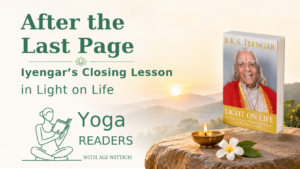
A TASTE OF YOGA READER'S LIGHT ON LIFE SESSION
While pain isn’t always bad, it’s essential to understand its limits. Guruji’s insights on treating pain without causing injury have been invaluable. My experiences with injuries, though not ideal, have taught me valuable lessons and shaped my practice.
What we resist most
From these pages I take a simple lesson. Pain belongs to the practice, and the part of ourselves that we resist most carries the most information. The body resists, the mind resists, and the resistance points to where understanding still waits to arrive. Iyengar even offers a gentle reason to welcome it: “We use right pain like a vaccine against the unavoidable pain and suffering that life always sends our way, but the dose must be correct” (p. 51). The dose, in his teaching, always comes with intelligence and love.
Vṛkṣāsana as a daily test
For me, Vṛkṣāsana (tree pose) shows the whole chapter in a single posture. It tells me, on any given day, how well I can concentrate and how much strength I have in that moment. Iyengar describes the standing postures in similar terms: “Feet are like the root of a tree. If one can’t stand properly on one’s feet, one develops a negative attitude toward life, and one’s yoga too becomes unsteady” (p. 43). The tree pose simply reports.
Firmness, purity, sensitivity
Iyengar names the qualities that this chapter builds. “The keys to unlocking our potential are the qualities of purity and sensitivity” (p. 25). Purity here means śauca, cleanliness, the first of the niyamas, and he gives it a practical reading: “purity permits sensitivity. Sensitivity is not weakness or vulnerability. It is clarity of perception and allows judicious, precise action” (p. 25). A body that raises itself in this way becomes an instrument that registers accurately, and the soul has something reliable to work with.
Questions for reflection
- Which injury or difficulty taught you the most about your body?
- When you feel resistance in a posture, how do you tell right pain from wrong pain?
- Which standing pose acts as your daily test, and what does it show you today?
If this essay spoke to you, join the Yoga Readers community. We read Light on Life chapter by chapter, and new essays reach subscribers before each session.
Join Yoga Readers
- The Zoom link and a reminder before every session
- The reading schedule and chapter summaries
- Focus questions and reflection prompts for each session
- The Yoga Readers Guide: how to read along and get the most from the journey
✅Is Yoga Readers free?
Yes. Everyone can take part in the live Yoga Readers reading, free of charge. You receive:
- Live Zoom gatherings, twice a month
- The reading schedule
- Short chapter summaries
- Session summaries: what we explored in each gathering
- Focus questions and reflection prompts on the website
- Our WhatsApp and Facebook groups
- Recordings of the Opening Gathering, the Closing Gathering, and the special conversation with a senior teacher
If you want to read, show up, and think together, you have everything you need.
Keep the whole cycle
Missed a session, or want to return to one? The Study Pack keeps every session recording and the Study Companion PDF with the themes, summaries, questions, and Sanskrit terms, so you can come back to the cycle for months and years.
Early-bird NIS 249 (~$78) until 20 December 2026