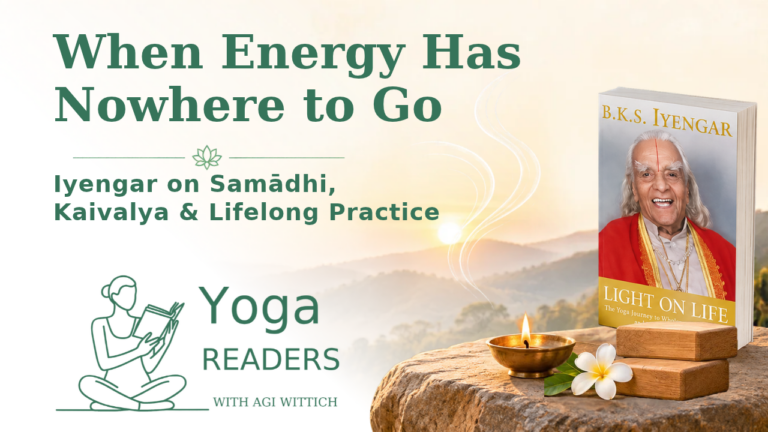
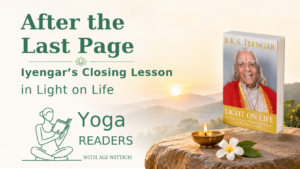
This essay belongs to our Yoga Readers reading of B.K.S. Iyengar’s Light on Life. We meet free on Zoom from Sunday, 17 January 2027. → Join the reading
We live in a culture that mistakes voltage for vitality: more plans, more messages, more breathwork downloaded at midnight. Chapter 3 of Light on Life offers a calmer approach. Iyengar wants energy, and he wants a body and mind that can hold it. “Prana is special because it carries awareness. It is the vehicle of consciousness. If you want to send your awareness to the furthermost cell of your big toe, prana will carry it there” (pp. 67–68). The word prāṇa names the vital energy that rides on the breath, and prāṇāyāma joins prāṇa to āyāma, which Iyengar glosses as “stretch, extension, expansion, length, breadth, regulation, prolongation, restraint, and control” (p. 66).
The electric current and the house
Iyengar offers a household image first:
“If you were suddenly to triple the strength of the electrical current arriving in your house, you would not think the kettle would boil in a third of the usual time and your lights burn three times brighter. You know you would immediately burn out all the circuits and be left with nothing.” (pp. 66–67)
He applies it to Patañjali’s order of practice. Between āsana and prāṇāyāma “there is a step up,” and proficiency in āsana builds “strength and stability in the circuitry of the body to withstand the increase in current that pranayama practice will bring” (p. 67). In his teaching, readiness covers the emotions as well as the muscles.
A TASTE OF YOGA READER'S LIGHT ON LIFE SESSION
These moments of clarity, what we call “aha” moments, come unexpectedly. Tradition teaches that deep meditation brings them about, but truly, they can arise at any time, in any place.
The hydroelectric image
A few pages later he offers the image that gives the essay its theme:
“The analogy of the production of energy through hydroelectric power may prove helpful. Stagnant water can create no energy, which means if you are not breathing, you are dead. If you are breathing normally, there is some flow, and you produce just enough energy for the requirements of the moment. But there is no surplus to be invested in other projects. It is only by the techniques of pranayama, which regulate, channel, and (in retention of breath) dam the flow all the better to harness and extract its inherent power, that we produce sufficient energy to vitalize the whole system.” (p. 71)
A dam gives a river a shape. The water gathers, the pressure builds, and the current can then light a house. Absent a dam, the same water floods a field. Iyengar adds the elemental detail: prāṇāyāma is “the technique of generating cosmic vital energy through the fusion of the antagonistic elements of fire and water,” and the breath is “the interface whose flow in the lungs provides the dynamic stream that fuses water and fire” (p. 71). Fire stands for the quick, drying mind, and water for the tidal body. The breath gives them a place to meet.
A day that feels like a week
In India, a single day can feel like a week, because events and experiences arrive in such quantity. On those days I feel the question of Chapter 3 in my own body: what holds all this current? Sometimes the answer is a simpler āsana. Sometimes it is an early night. Iyengar’s teaching tells me that generating energy and holding it belong to two different skills, and the second one supports the first.
Learning to love the breath
I loved prāṇāyāma from the beginning. I preferred sitting, and it took me time to grow used to lying down for the practice. In the Iyengar method a supported reclining position serves a purpose: the floor and the props hold the spine, the chest opens, and the practitioner learns the breath before asking the body to carry the posture.
Iyengar himself found the road long. “I did not start the practice of pranayama until 1944 when I had already been teaching yogasana for several years. You can take comfort from the fact that however poor your own pranayama is, it can scarcely be worse than mine was for the first few years” (p. 69). He describes the gap between intention and action with honesty: “Everybody needs a teacher for pranayama. I had no one and fell into the gap between ‘knowing’ and ‘doing.’ I knew I had to take a deep, slow breath, but it did not happen. I could not do it” (p. 70). Then comes the turn: “It was my asana practice that kept me on track” (p. 70). Years of āsana prepared the vessel, and the breath eventually settled into it.
Inviting the breath
His advice on technique stays gentle. “You cannot catch a horse in a field by running after it. But if you stand still and hold out an apple, the horse will come to you” (p. 73). Prāṇa “has to be invited, enticed,” and he adds a line that every practitioner can test tonight: “Let the breath and the intelligence move simultaneously. If the intelligence moves first, you are using force” (p. 74).
Questions for reflection
- Where in your life do you generate more current than you can presently hold?
- What would a wiser “dam” look like this month: an earlier night, a simpler āsana, one practice fewer?
- How does your own experience of prāṇāyāma differ when you sit and when you lie down?
If this essay spoke to you, join the Yoga Readers community. We read Light on Life chapter by chapter, and new essays reach subscribers before each session.
Join Yoga Readers
- The Zoom link and a reminder before every session
- The reading schedule and chapter summaries
- Focus questions and reflection prompts for each session
- The Yoga Readers Guide: how to read along and get the most from the journey
✅Is Yoga Readers free?
Yes. Everyone can take part in the live Yoga Readers reading, free of charge. You receive:
- Live Zoom gatherings, twice a month
- The reading schedule
- Short chapter summaries
- Session summaries: what we explored in each gathering
- Focus questions and reflection prompts on the website
- Our WhatsApp and Facebook groups
- Recordings of the Opening Gathering, the Closing Gathering, and the special conversation with a senior teacher
If you want to read, show up, and think together, you have everything you need.
Keep the whole cycle
Missed a session, or want to return to one? The Study Pack keeps every session recording and the Study Companion PDF with the themes, summaries, questions, and Sanskrit terms, so you can come back to the cycle for months and years.
Early-bird NIS 249 (~$78) until 20 December 2026